ARP Termination
Feature Overview
ARP Termination is used on network Edge devices for several important reasons:
- Traffic Reduction: Intercepting ARP requests and responding on behalf of known destinations significantly reduces ARP broadcast traffic across the network.
- Improved Scalability: Limiting ARP broadcasts enhances scalability in large network deployments, particularly in data center environments with numerous endpoints.
- Performance Enhancement: Reducing unnecessary ARP traffic leads to improved overall network performance and reduced latency.
- Efficient Address Resolution: The RUCKUS Edge device maintains a table mapping IP addresses to MAC addresses, allowing for quicker and more efficient address resolution without flooding the network with ARP requests.
- Security Enhancement: Limiting the scope of ARP broadcasts improves network security by making it more difficult for potential attackers to gather information about the network topology.
- Bandwidth Conservation: Reducing the flooding of ARP messages in the network helps conserve core bandwidth.
The data plane component of the RUCKUS Edge device handles ARP requests. Typically, without the ARP Termination feature, when it receives an ARP request for a remote IP address, it forwards the request by flooding it across the Layer 2 (L2) network. This flooding causes a broadcast storm, affecting all APs in the L2 domain. The APs react to these broadcast packets by reducing their transmission rate on the wireless network. This leads to a decrease in network bandwidth available for regular data traffic.
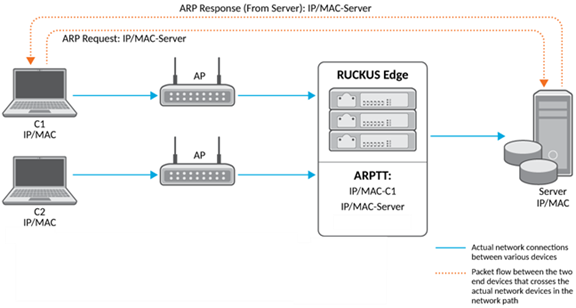
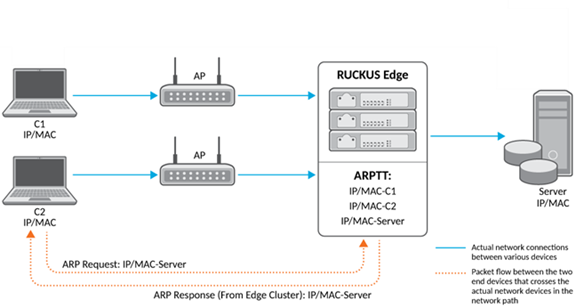
A detailed explanation of the key components and processes are as follows:
- ARP Termination builds and maintains the ARP Termination Table (ARPTT) by learning IP-to-MAC bindings from ARP Request and Response packets.
- When processing ARP Requests:
- For C1 messaging, since the ARPTT is empty, ARP request and response traffic is exchanged directly between C1 and the server but the Edge Cluster learns and updates the following into the ARPTT:
- For C2 messaging, the ARP request is intercepted and processed by the Edge since the ARPTT has the entry IP/MAC-Server.
- ARP Termination maintains separate ARPTTs for IPv4 and IPv6.
- Each ARPTT supports up to 50,000 entries. Once this limit is reached, an event is generated, and no new entries are added until existing entries age out.
Requirements
Ensure that the RUCKUS Edge firmware version is at least 2.3.0.1181 to support this feature.
Limitations
The total number of IP to MAC bindings cannot exceed the maximum number of entries in each of the IPv4 and IPv6 tables. The ARP request packet will flood the network in the same manner as standard Layer 2 broadcast forwarding. When the ARP Termination table reaches the maximum capacity of entries, no new ARP entries can be added until some of the existing entries expire.
Considerations
The ARP termination feature is enabled by default, with the ARP Termination Aging Timer set to a default value of 600 seconds.
Best Practices
Implementing ARP termination in RUCKUS Edge can enhance network performance and security. Here are some good practices to consider:
- Enable ARP Inspection: Configure ARP inspection on the relevant VLANs to ensure that only valid ARP requests and responses are allowed. This helps prevent ARP spoofing attacks.
- Use Static ARP Entries: Where possible, use static ARP entries for critical devices. This can prevent unauthorized devices from communicating on the network.
- Segment the Network: Properly segment the network using VLANs to limit the broadcast domains and reduce unnecessary ARP traffic.
- Implement IP Source Guard: Use IP Source Guard to bind IP addresses to specific MAC addresses and switch ports. This ensures that only legitimate devices can communicate on the network.
- Monitor and Log ARP Traffic: Regularly monitor and log ARP traffic to detect and respond to any suspicious activity promptly.
Prerequisites
This feature has no prerequisites to feature enablement or usage.