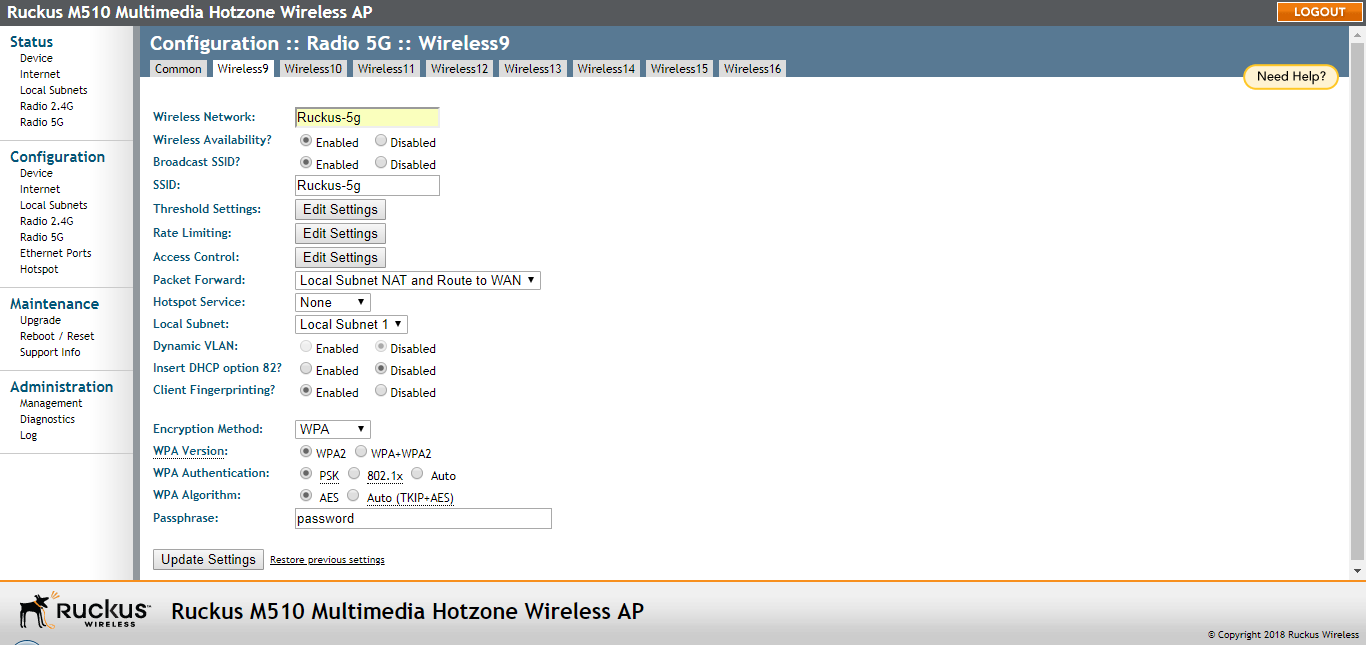
Configuring Wireless # (WLAN Number) Settings
The AP provides up to eight wireless LANs per radio that can be individually configured
to provide different kinds of services for different kinds of wireless clients, traffic
types or different user groups.
- Go to Configuration > Radio 2.4G/Radio 5G. The Configuration > Radio 2.4/5G > Common page appears.
- Click one of the eight Wireless (#) tabs. The Configuration > Wireless > Wireless [#] page appears.
- Review the WLAN options listed in the following table, and then make changes as required.
WLAN options
Option Description Wireless Network This wireless network name is for management purposes only, and is not visible to the user. Wireless Availability This option controls whether or not the wireless network is available to users (Enabled or Disabled). Broadcast SSID This option controls whether or not the WLAN SSID is visible to anyone looking for wireless networks. Disabling (hiding) the SSID requires the user to be told the correct SSID before they can connect to your network. SSID This is the publicly-broadcast “name” of your wireless network. SSIDs can contain up to 32 alphanumeric characters and are case-sensitive. The SSID can only contain between 2 and 32 characters, including characters from ! (char 33) to ~ (char 126). Threshold Settings This button opens a page where you can configure the Protection Mode you activated on the Configuration > Wireless > Advanced > Wireless [#] page. If Protection Mode is not active, ignore this option. For more information, refer to Setting Threshold Options. Rate Limiting This button opens a page where you can configure upload and download limits per station. For more information, refer to Rate Limiting. Access Control This button opens a page where you can configure access controls for the WLAN. For more information, refer to Controlling Access to the Wireless Network. Packet Forward - Isolated: Selecting Isolated causes the traffic from this WLAN to terminate at the AP.
- Bridge to WAN: The default setting, Bridge to WAN forwards packets arriving on this WLAN to the WAN (uplink) port and eventually to their external destinations using Layer 2 forwarding.
- Local Subnet NAT and Route to WAN: This setting allows routing of wireless packets to their destinations using Layer 3 network address translation (NAT).
- Bridge to L2TP Tunnel: Uses Layer 2 Tunneling Protocol to deliver packets encapsulated with an L2TP header in UDP datagrams.
Hotspot Service Select a Hotspot configuration from the list to enable Hotspot service on this WLAN, if you have configured it from the Configuration > Hotspot page. See Configuring Hotspot Service. Local Subnet This option appears if you have selected Local Subnet NAT and Route to WAN under Packet Forwarding, and allows you to choose which subnet this WLAN's traffic is part of. You must have previously configured a subnet from the Configuration > Local Subnets page before it becomes available here. Access VLAN Enter a VLAN ID to segment all traffic arriving from this WLAN to a specified VLAN. Default is 1. Dynamic VLAN This setting is available only with WPA encryption and 802.1X authentication. Dynamic VLAN allows the dynamic assignment of VLANs to clients based on RADIUS attributes. Enable this option only if your RADIUS server is configured to segment clients using dynamic VLAN. Insert DHCP Option 82 When this option is enabled on an SSID, additional information is encapsulated in DHCP option 82 and inserted into DHCP request packets. Current format of option 82 is: Circuit ID sub-option: WLAN:<IFNAME>:<VLAN>:<SSID>:<MODEL>: <HOSTNAME>:<DEVMAC> This option supports the ability for a service provider to allocate IP addresses intelligently by considering information on the origin of the IP allocation request. Client Fingerprinting When this option is enabled, the AP attempts to identify client devices by their operating system, device type and host name, if available. Encryption Method By default, all data exchanges on your wireless network are not encrypted, but you can select an encryption method in this option, and use the extra workspace features that appear to fine-tune the encryption settings. Ruckus strongly recommends using WPA as the encryption method as WEP is easily circumvented. For more information, refer to either Using WEP or Using WPA. - When you are finished, click Update Settings to save and apply the changes. A confirmation message appears at the top of this page.
- Click Go back to Wireless Configuration to reopen the previous page.