Adding and Managing Configuration Templates
- In the navigation bar, select
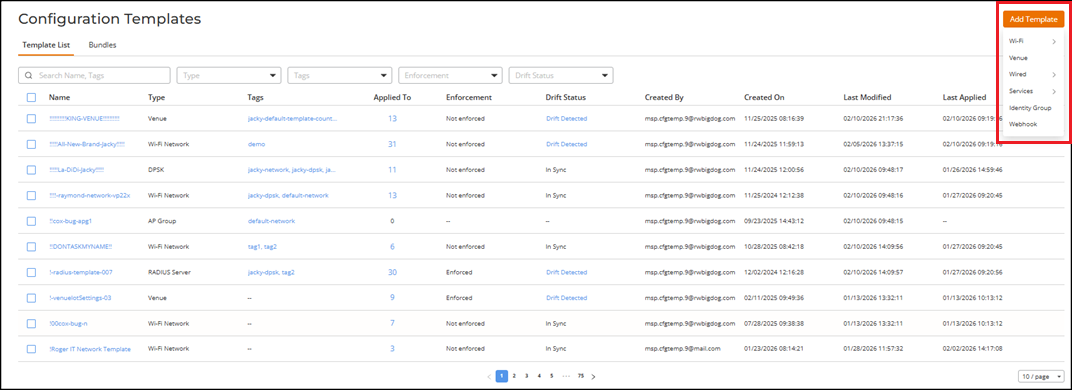
.The Configuration Templates page is displayed with the following information:
- Name: Displays the template name as a hyperlink.
Clicking the hyperlink opens the Template Details
sidebar.
The Template Details sidebar displays the following information: Template Name, Type, Drift Status, Enforcement, Created By, Created On, Last Modified, Last Applied, Configuration Details, Active on Networks and Applied to.
- Drift Status: Displays the current drift status. If a drift is detected, a Drift Detected hyperlink appears. Clicking the hyperlink opens the Drifts Report sidebar. Refer to Viewing and Syncing Config Template Drifts for more information.
- Configuration Details: The View Configuration hyperlink opens the configuration details page for the selected template and displays all defined parameters and values. When a template is enforced, all fields appear in read-only mode. For non-enforced templates, click Configure to modify editable fields. The View Configuration hyperlink appears only for templates that contain saved configuration data; the hyperlink is inactive when no configuration is available.
- Type: Displays the template category, such as Wi-Fi Network, Venue, or Service.
- Tags:
Displays the tags associated with the template as a hyperlink. Clicking
the hyperlink opens the Manage Tags sidebar. Refer
to Adding and Managing Tags for more information. If -- is displayed,
the template has no tags assigned.
ACX-103139: Config Template 5 - Tagging
- Applied
To: Displays the total number of venues, networks,
customers, devices, or clusters to which the template is
applied.
Customers - in case of webhooks
- Enforcement: Displays whether the template is enforced or not enforced. If -- is displayed, the template is not enforced and the Enforce template configuration option is not supported by the template type.
- Drift Status: Displays the current drift status. If In Sync is displayed, there is no drift between the template and its instances, indicating that all changes have been successfully synchronized. If a drift is detected, a Drift Detected hyperlink appears; clicking the hyperlink opens the Drifts Report sidebar. If -- is displayed, the template has never experienced drift. Once drift is detected, the status changes to Drift Detected. After a successful synchronization, it updates to In Sync. Thereafter, the status alternates between Drift Detected and In Sync, and does not revert to --.
- Created By: Displays the username of the administrator who created the template.
- Created On: Displays the date and time when the template was created.
- Last Modified: Displays the date and time when the template was last modified.
- Last
Applied: Displays the date and time when the template
was last applied. If -- is displayed, the template has never been applied to any
device.
You can use the Search option to display only the table entries matching the specified Name or Tags; enter a minimum of two characters. Additionally, you can filter the list of configuration templates by selecting options from the drop-down menus of the Type, Tags, Enforcement, and Drift Status fields. The type menu supports multiple selections, including Access Control, AP Group, Application Policy, Device Policy, DHCP for Wi-Fi, DPSK, Guest Portal, Identity Group, IPSec, Layer 2 Policy, Layer 3 Policy, RADIUS Server, Rogue AP Detection, Switch CLI Profile, Switch Regular Profile, Syslog Server, Tunnel Profile, Venue, VLAN Pool, Wi-Fi Calling, and Wi-Fi Network. The tags drop‑down displays all tags currently available in the account. The enforcement options are Enforced and Not Enforced. The drift status options are Drift Detected and In Sync. Use the Clear Filters option to remove the applied filters.
ACX-103139: Config Template 5 - Tagging. Hide Tags and "The tags drop‑down displays all tags currently available in the account."
- Name: Displays the template name as a hyperlink.
Clicking the hyperlink opens the Template Details
sidebar.
- On the Configuration Templates page, click Add Template.
- Select a template type and
follow the on-screen instructions to complete the configuration.
- Note:
- This topic assumes that you are familiar with the process of configuring Wi-Fi networks, AP groups, venues, wired switch profiles, services, identity groups, and webhooks using the RUCKUS One portal. Refer to the RUCKUS One User Guide for more information.
- Identity Group is a required field for many network types and services, ensuring proper deployment and functionality.
- Networks and services reference the identity groups. When configuring a new network or service, you have the option to select an existing identity group or create a new one.
- Wi-Fi:
Select this option to create a Wi-Fi network or AP Group configuration
template. The following options are available:
- Wi-Fi Network: Select this option to create a Wi-Fi network configuration template. The Enforce template configuration option appears on the configuration page. Toggle it on to ensure that all direct changes on template-activated elements are blocked to enforce compliance with the template configuration.
- AP Group: Select this option to create an AP group configuration template.
- Venue:
Select this option to create a venue configuration template. The
Enforce
template configuration option appears on the
configuration page. Toggle it on to ensure that all direct changes on
template-activated elements are blocked to enforce compliance with the
template configuration.
Note: When the country in the Address field is set to any location within the United States, the default 2.4 GHz channels 1, 6, and 11 are automatically applied to the Venue Template upon creation.
These default channel settings are not visible during template creation. They become visible only after the template is applied and a venue is created in the user account.
- Wired: Select this option to create a configuration template for RUCKUS ICX switches. The following options are available:
- Services:
Select this option to create a service configuration template. The
following options are available:
- Access Control: Select this option to create an access control configuration template.
- DHCP for Wi-Fi: Select this option to create a DHCP service configuration template for Wi-Fi.
- DPSK: Select this option to create a DPSK service configuration template. The Enforce template configuration option appears on the configuration page. Toggle it on to ensure that all direct changes on template-activated elements are blocked to enforce compliance with the template configuration.
- Ethernet Port Profile: Select this option to create an Ethernet port profile configuration template.
- Guest Portal: Select this option to create a guest portal configuration.
- RADIUS Server: Select this option to create a RADIUS server configuration template. The Enforce template configuration option appears on the configuration page. Toggle it on to ensure that all direct changes on template-activated elements are blocked to enforce compliance with the template configuration.
- Rogue AP Detection: Select this option to create a rogue AP detection configuration template.
- Syslog Server: Select this option to create a syslog server configuration template.
- Tunnel Profile: Select this option to create a tunnel profile template used to define AP‑to‑Edge or L2GRE tunneling behavior, including tunnel type, destination Edge cluster or IP, segmentation mode, MTU settings, and keepalive parameters.
- VLAN Pools: Select this option to create a VLAN pool configuration template.
- Wi-Fi Calling: Select this option to create a Wi-Fi calling configuration template. The Enforce template configuration option appears on the configuration page. Toggle it on to ensure that all direct changes on template-activated elements are blocked to enforce compliance with the template configuration.
- Identity Group: Select this option to create an identity group configuration template.
- Webhook:
Select this option to create a webhook configuration template. The
Enforce
template configuration option appears on the
configuration page. Toggle it on to ensure that all direct changes on
template-activated elements are blocked to enforce compliance with the
template configuration.
ACX-91084 - Webhooks Service. Future Rel - Webhooks option in R1 Config template
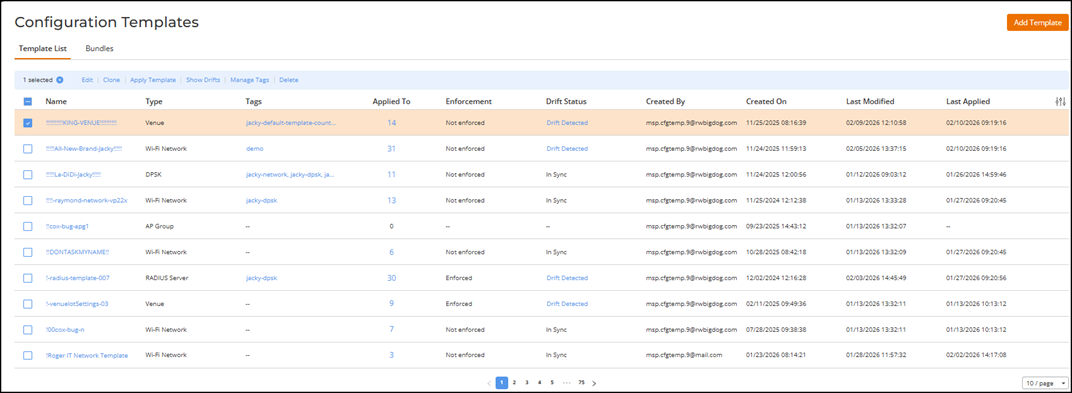
- (Optional) You can manage
configuration templates from the Configuration Templates
page using the following options:Note: Available options differ based on the type of template selected and whether drift is detected.
- Edit:
Click the checkbox alongside the template name and click Edit.
The selected template page is displayed, showing fields and tabs specific to the template type. You can view or modify configuration details and click Save to apply changes.
- Clone: Click the checkbox alongside the template name
and click Clone.
- The
Clone Template dialog box appears
where you can enter the new Name (up
to 32 characters) and click
Save.
Note: The Clone operation is supported only for Wi-Fi Network, Venue, DPSK, Webhook, and Wi-Fi Calling configuration templates.Note: AP Group template cloning is triggered by the venue template clone process. When you clone a venue configuration template, all its non-default AP Groups are automatically cloned as part of the workflow. AP Group configuration templates cannot be directly, manually cloned from the MSP Configuration Templates page.
- The
Clone Template dialog box appears
where you can enter the new Name (up
to 32 characters) and click
Save.
- Apply
Template: Select one or more checkboxes alongside
the template name and click Apply
Template. Refer to Applying a
Configuration Template to an End Customer for more
information.
ACX-120157
- Show
Drifts: Click the checkbox alongside the template
name and click Show
Drifts to view and synchronize configuration
differences between the applied configuration and the template.
Refer to Viewing and
Syncing Config Template Drifts for more information.
- Manage
Tags: Click the checkbox alongside the template name
and click Manage Tags. Refer to Adding and Managing Tags for more
information.
ACX-103139: Config Template 5 - Tagging
- Delete: Select one or more checkboxes alongside the
template name and click DeleteNote: You can delete multiple templates in a single operation. If any selected template is currently in use, the Delete action is disabled. Deselect the templates in use to proceed.A delete configuration confirmation dialog box appears. Click Delete Config Template to confirm deletion.ACX-120157
- Edit:
Click the checkbox alongside the template name and click Edit.