NTP over Management VRF
Virtual Routing and Forwarding (VRF) is a technology that divides network traffic into different logical VRF domains. Using VRF, multiple routing tables and forwarding tables (FTs) can exist in one routing device with one routing table for each VRF instance. A VRF-capable router can function as a group of multiple virtual routers on the same physical router. VRF, in conjunction with virtual private network (VPN) solutions, guarantees privacy of information and isolation of traffic within a logical VRF domain.
When NTP is configured over the management VRF, the NTP traffic is routed through the management VRF. NTP over Management VRF is used to provide secure management access to the device by sending outbound NTP traffic through the VRF specified as a global management VRF, which isolates NTP traffic from the network data traffic.
The following figures illustrate some potential use case scenarios for NTP over Management VRF.

In this scenario, NTP over Management VRF is implemented on both an NTP server and an NTP client device using Virtual Ethernet (VE) interfaces.
Use Case 2: NTP Server over Management VRF with One Client Using Management VRF and Another Client Using Ethernet

In this scenario, the NTP server has one client using Management VRF and one client using an Ethernet port.
Use Case 3: NTP Server over Management VRF with One Client on Management VRF and One Client on Management Port
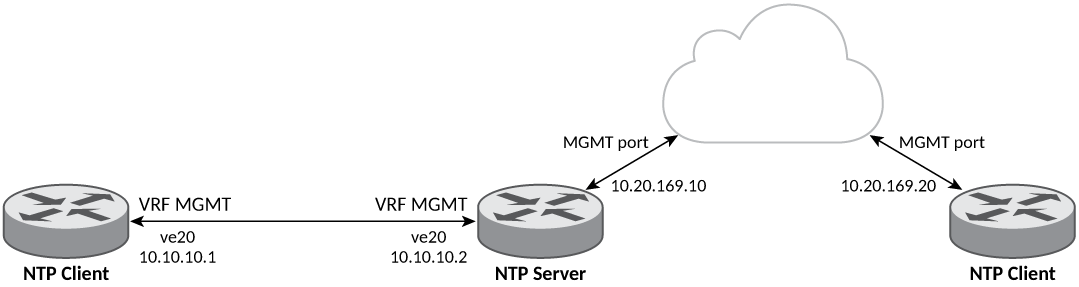
In this scenario, the NTP server has one client using Management VRF and one client on a management port.