vSZ-D Logical Interfaces
The Virtual SmartZone Data Plane (vSZ-D)
uses two distinct logical interfaces to separate control-plane traffic from data-plane
traffic. This separation is critical for stability and performance because management
operations must remain unaffected by high-volume user data flows.
- The management interface. It is dedicated to communication between the vSZ-D and the controller (vSZ-H). It carries configuration updates, monitoring information, and system control messages. This interface is typically placed on a control VLAN and assigned an IP address that the controller can reach without ambiguity.
- The data interface. It handles user traffic. It terminates GRE tunnels from access points and processes client data, including DHCP requests and NAT operations. Because this interface deals with real-time traffic, it is configured on a VLAN that aligns with the AP data path. Its design allows DHCP messages from clients to traverse the tunnel and reach the data plane, where they are either relayed or resolved locally, depending on the deployment model.
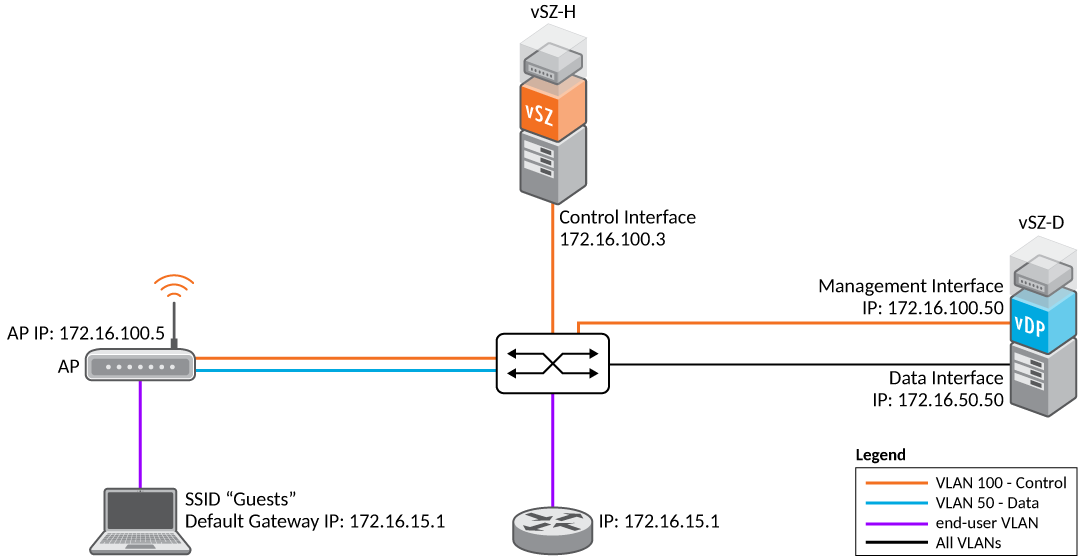
vSZ-D Logical Interfaces illustrates how to configure the vSZ-D management and data interfaces so they properly handle control traffic and client data in a typical deployment.
- DP management interface (VLAN
100): The vSZ-D management interface is configured on VLAN 100 with IP address
172.16.100.50. The controller uses IP address172.16.100.3and the AP uses IP address172.16.100.5This VLAN is reserved for control traffic between the vSZ controller and APs, as well as DP control communication. - Data interface (VLAN 50): The
vSZ-D data interface is configured on VLAN 50 with IP address
172.16.50.50. This interface is responsible for terminating GRE tunnels from APs and processing client data traffic. - AP connectivity: The AP communicates with the controller through VLAN 100 for control and uses VLAN 50 to connect to the vSZ-D for tunneling client data.
- Client traffic: Traffic originating from the SSID Guests passes through the tunnel to the vSZ-D data interface. From there, the data plane forwards packets toward their destination, which may be the internet or an internal network.