Multi-Tunnel Support for Access Points
Multiple Tunnel Support enables RUCKUS Access Points (APs) managed by SmartZone (SZ) to establish and maintain up to four concurrent tunnel connections to different data planes. This feature is designed to enhance network segmentation, support multi-tenant environments, and provide flexible traffic forwarding options for enterprise and managed service provider (MSP) deployments.
Support for multiple tunnels on APs includes the following key capabilities:
- Simultaneous tunnel connections. Each AP can maintain up to four active tunnels: one RUCKUS GRE (RGRE) tunnel to the SZ data plane and up to three SoftGRE tunnels to external GRE gateways.
- SSID-Based tunnel assignment. You can map each SSID (WLAN) to a specific tunnel. All client traffic on a given SSID is forwarded through the assigned tunnel.
- Traffic segmentation. Enables logical separation of user groups, services, or tenants by directing their traffic through dedicated tunnels.
- Centralized and distributed data planes. Supports hybrid architectures by allowing APs to forward traffic to both centralized (SZ-D) and distributed (external GRE gateway) data planes.
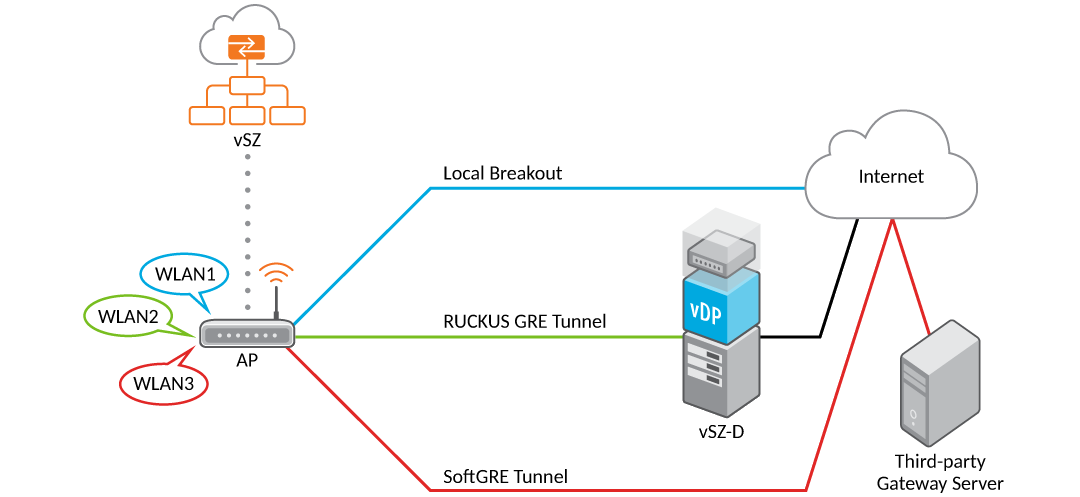
Multiple Tunnel Support illustrates the multi-tunnel capabilities available on the vSZ-managed APs. The diagram depicts an AP managed by a vSZ controller, broadcasting three separate WLANs (WLAN1, WLAN2, and WLAN3). Each WLAN demonstrates a distinct data forwarding path:
- WLAN1 utilizes a local breakout configuration, directing client traffic from the AP directly to the internet without traversing any intermediate data plane.
- WLAN2 forwards client traffic from the AP to a vSZ-D (Virtual SmartZone Data Plane) instance using a RUCKUS GRE tunnel. The vSZ-D then provides connectivity to the internet.
- WLAN3 routes client traffic from the AP to a third-party gateway server across the internet via a SoftGRE tunnel, with the third-party gateway server subsequently connecting to the internet.
The figure also shows the management and control relationship between the AP and the vSZ controller, indicated by a dotted line. This architecture enables assignment of different simultaneous traffic-handling policies for each WLAN, supporting scenarios such as direct internet access, centralized data processing, or integration with external data processors.