Deployment Topologies in NAT Environments
Data Plane Behind NAT in a Data Center
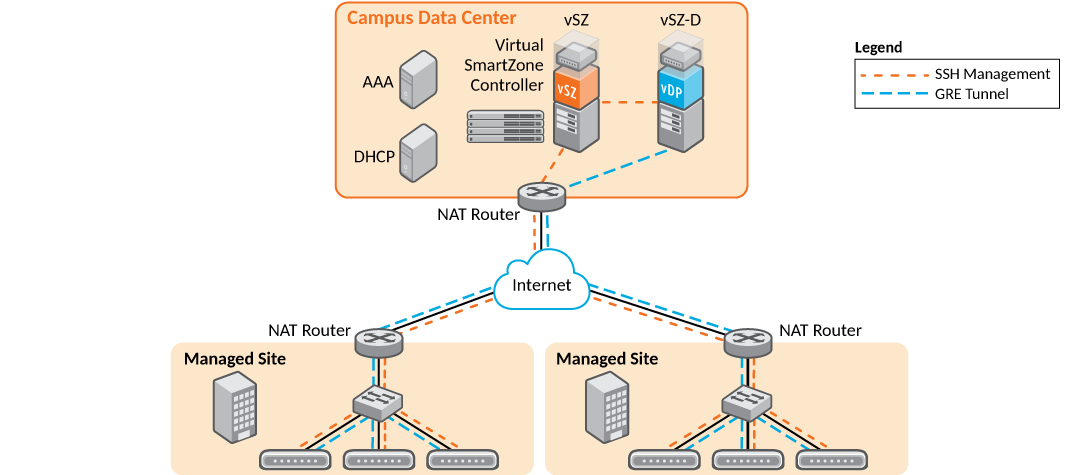
When the Data Plane is deployed behind a NAT router, it operates in a private network and communicates with APs in the public network through NAT. In this scenario, you must configure a public IP address and port pair during the Data Plane setup process. The Virtual SmartZone (vSZ) uses this public address and port information to notify APs of the correct destination for their connections.
Data Plane at Access Site with NAT
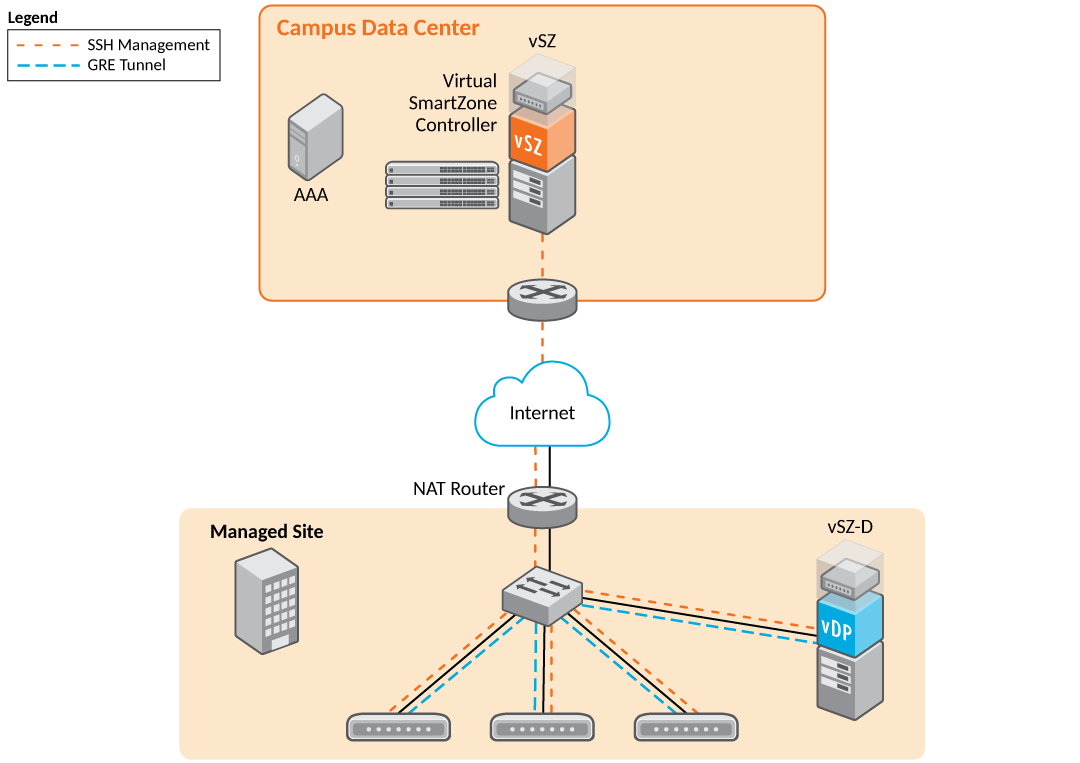
When an Access Point (AP) is behind a NAT device, the AP operates in a private network and communicates with the Data Plane in the public network through NAT. The AP uses its private IP address for local connectivity, but all traffic to the Data Plane is translated by the NAT device.
During communication, the NAT device intercepts packets from the AP, replaces the source IP address with a public IP address, and assigns a new source port before forwarding the packet to the Data Plane. The Data Plane does not require any special configuration for this translation, instead, it remains unaware of the NAT operation. For return traffic, the NAT device translates the destination IP address and port back to the AP’s original private IP and port.
DHCP Relay with NAT
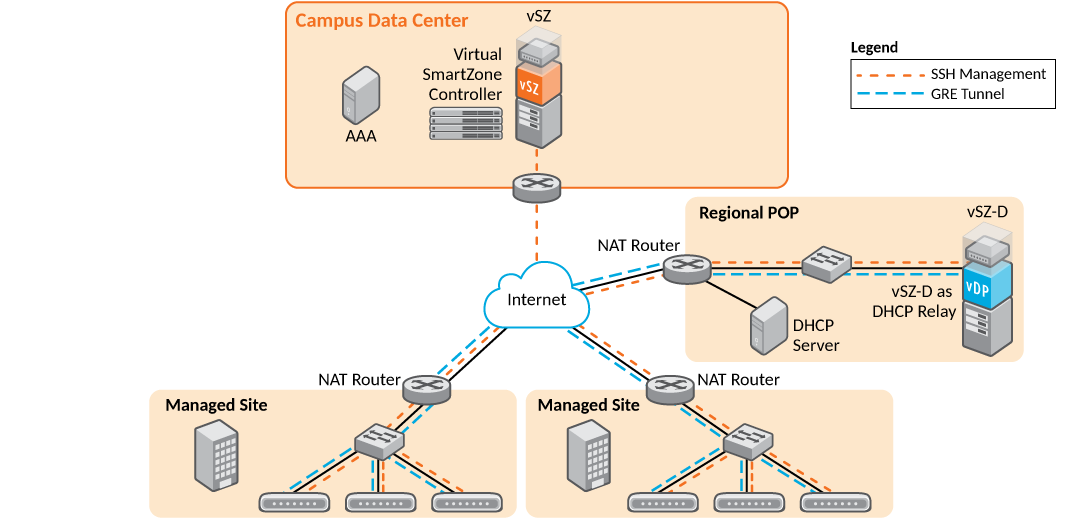
In this topology, Virtual SmartZone (vSZ) is located in the data center, and the Data Plane is deployed at a distributed site but not co-located with APs. NAT devices exist between vSZ and the Data Plane, and between the Data Plane and APs.
Unlike previous topologies, the DHCP server that assigns client IP addresses resides on a separate subnet. To support this configuration, the Data Plane provides a DHCP relay function, forwarding DHCP requests and responses between APs and the external DHCP server through the NAT devices.