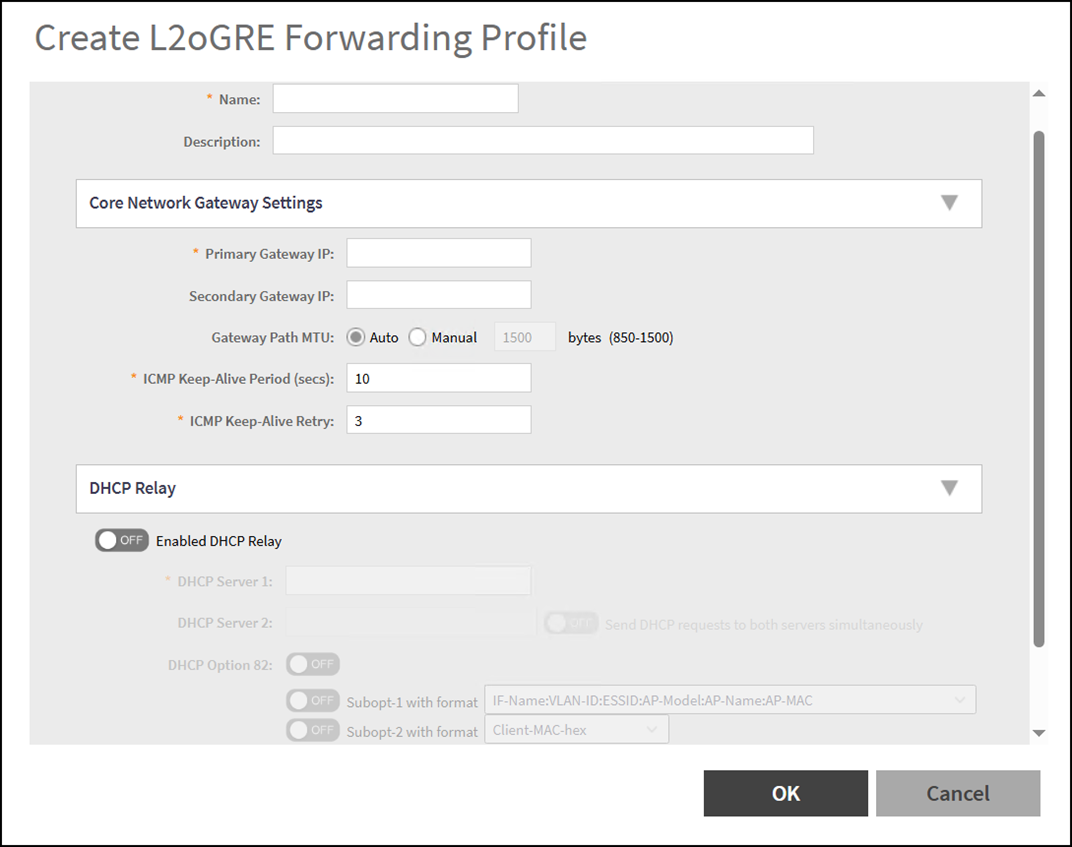
Creating L2oGRE Forwarding Profiles
A Layer 2 over GRE (L2oGRE) forwarding
profile encapsulates decapsulated AP traffic in Generic Routing Encapsulation (GRE)
and
forwards Layer 2 frames to a specified gateway. The profile determines the Core Network
Gateway Settings, including destination IP addresses, Path MTU behavior, and ICMP
keepalive
parameters, and can include DHCP Relay options.
Note: This feature is applicable for the vSZ-H
and SZ300 platforms.
- In the controller web UI, select .
- Click Create.
- In Name, enter a unique profile name.
- (Optional) In Description, enter a brief purpose statement.
- In Core Network Gateway
Settings, configure the following:
- Primary Gateway IP: Enter the IPv4 address of the primary L2oGRE gateway that terminates the GRE tunnel. The controller encapsulates Layer‑2 frames in GRE and sends them to this destination.
- Secondary Gateway IP: Enter a backup L2oGRE gateway. The controller uses this destination if the primary gateway is unreachable (as determined by the keep‑alive logic).
-
Gateway Path MTU: Controls the GRE payload size toward the gateway. Select one of the following:
- Auto: The controller determines an MTU suitable for the DP-to-gateway path. Use this when intermediate links vary or when you do not control the underlay. This is the default setting.
- Manual: Enter a byte value (850–1500). Use Manual when the end‑to‑end path MTU is known and you want predictable fragmentation behavior. A too‑large MTU can cause drops; a too‑small MTU can reduce throughput due to fragmentation/overhead.
- ICMP Keep‑Alive Period (secs): Interval between probe messages (ICMP echo) sent to validate reachability of the L2oGRE gateway. Smaller values detect failures faster but add probe traffic; larger values reduce overhead but increase failover detection time. The default value is 10 seconds.
- ICMP Keep‑Alive Retry: Maximum number of consecutive failed probes before the gateway is considered unreachable. The default value is 3 retries. Together with the period, this defines your detection window (for example, Period 10 seconds × Retry 3 = ~30 seconds to declare down).
- (Optional) Set Enabled DHCP Relay to ON and do one of the
following:
- Configure a single DHCP
server:
- In DHCP Server 1, enter the server IPv4 address.
- (Optional) Enable DHCP Option
82, then configure any required sub‑options.
- Subopt‑1 with format: Choose a string format from the drop-down menu to define how relay agent information is encoded in DHCP requests. Typical formats combine interface name, VLAN ID, ESSID, AP model, AP name, and AP MAC address. This helps the DHCP server identify where the request originated and apply location-based policies.
- Subopt‑2 with format: Choose the identifier from the drop-down menu. This option specifies how the client’s MAC address is presented to the DHCP server, enabling more granular tracking or filtering of client devices.
- Subopt‑150 with VLAN‑ID: Turn ON if your DHCP server requires this vendor-specific option. When enabled, the relay agent includes the VLAN ID in DHCP requests, allowing the DHCP server to assign IP addresses or policies based on VLAN membership.
- Subopt‑151 with format: Choose a format from the drop-down menu and enter the value. This option lets you include additional location or area information in DHCP requests. The DHCP server can use this data for advanced assignment or reporting.
-
Configure dual DHCP servers:
- In DHCP Server 1 and DHCP Server 2, enter both server IPv4 addresses.
- (Optional) Enable Send DHCP
requests to both servers simultaneously. This can improve
reliability and reduce client wait times in environments where
multiple DHCP servers are available, ensuring that clients receive
an IP address even if one server is slow or unreachable.
Attention: Use this feature only if your network design supports parallel DHCP responses and your DHCP servers are configured to handle simultaneous requests without causing conflicts.
- Configure a single DHCP
server: