Supported Modes of Operation
Direct I/O (Recommended for Performance)
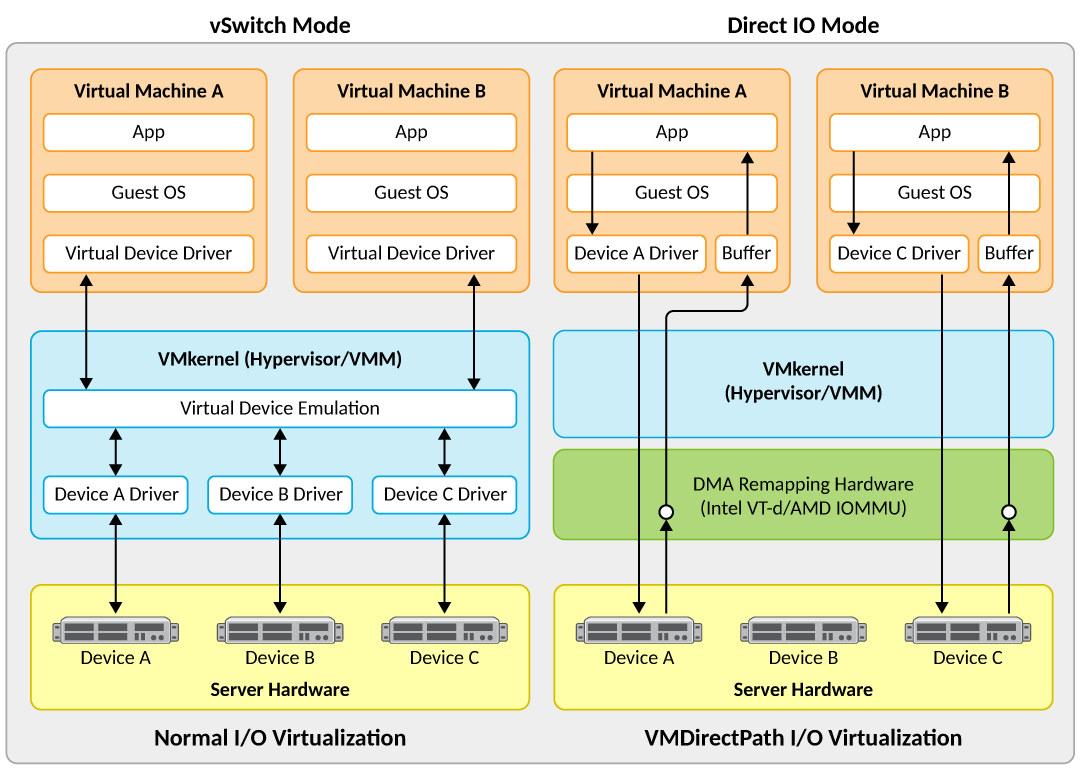
In Direct I/O, the vSZ‑D data interface is passed through directly to a DPDK‑capable NIC, bypassing the virtual switch in the hypervisor. This yields the highest packet‑forwarding throughput and lowest jitter, and is the recommended mode for production deployments with high tunnel counts and/or encryption overhead. NICs assigned to Direct I/O cannot be shared, and hypervisor features such as vMotion/DRS/HA are not available for those NICs.
Consider the following requirements and notes regarding this mode:
- Use Intel DPDK‑supported NICs (for example, I350/82599/X520/X710/XL710) and the corresponding drivers (igb/ixgbe/i40en).
- Management and Data interfaces must reside on different subnets; the Data interface uses the DPDK NIC.
- Historical sizing guidance shows a single vSZ‑D instance scaled to ~10,000 tunnels and ~10 Gbps unencrypted with appropriate 10 GbE adapters when operated in Direct I/O. Use this as directional guidance and validate against your target release.
vSwitch
In vSwitch mode, the vSZ‑D data interface uses the virtual NIC of the hypervisor and port‑group constructs (VMXNET3 on ESXi, virtio on KVM). This mode favors operational flexibility—standard vSwitch operations, easier NIC sharing, and simpler lifecycle on the hypervisor—at the cost of lower maximum throughput versus Direct I/O. Promiscuous mode must be enabled on the vSwitch port group used by the vSZ‑D data interface.
Consider the following requirements and notes regarding this mode:
Co‑Resident Deployment (Variant)
You may co‑locate the controller and vSZ‑D on the same hypervisor host in either Direct I/O or vSwitch mode. When doing so, reserve CPU/memory and isolate NIC resources to prevent resource contention with the controller VM.
Choosing a Mode
Consider the following when selecting the mode for the Data interface:
- Select Direct I/O if you need maximum forwarding performance and predictable latency for large AP/tunnel counts or heavy encryption, you are comfortable foregoing live‑migration features on that NIC, and you can dedicate DPDK‑capable adapters to vSZ‑D.
- Select vSwitch if you value operational flexibility (standard vSwitch operations, shared NICs, simpler host workflows) and your performance envelope is moderate; ensure Promiscuous Mode is enabled in the vSwitch port group for the data interface.