Features and Benefits

vSZ-D is a virtualized service to segregate and securely tunnel user data traffic.
Note: You can create a maximum of 2047 multicast groups on vSZ-D/SZ100-D/SZ144-D.

Some of the key use cases for the vSZ-D/SZ100-D/SZ144-D are:
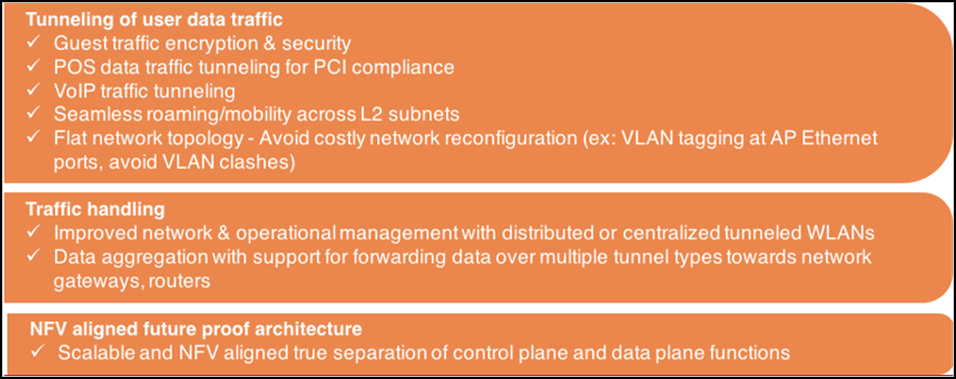
Use cases

Feature and Benefits

Feature Benefit
Secure data plane tunneling Manages the creation of aggregated user data streams through secure tunnel
Multiple Hypervisor Support Supports the most widely deployed VMware and KVM hypervisors, applicable only to vSZ-D.
Dynamic data plane scaling Supports 1Gbps, 10Gbps or even higher throughput capacities to support all types of enterprise and carrier deployments that can be dynamically tuned without needing software updates
Seamless integration with vSZ controller
  • Simple integration and management with vSZ controller clustering architecture enables support for multiple vSZ-D/SZ100-D/SZ144-D instances
  • vSZ + Data Plane services
    • 20 vSZ-D/SZ100-D/SZ144-D instances per vSZ instance
    • 80 vSZ-D/SZ100-D/SZ144-D instances per vSZ cluster of 4 instances

    Workaround:

    • If Flexi-VPN/L3 Roaming/Network Segmentation is enabled, user shall not be able to approve more than 40 DPs.
    • If Flexi-VPN/L3 Roaming/Network Segmentation is not enabled and the user adds more than 40 DPs, then Flexi-VPN/L3 Roaming/Network Segmentation setting shall be greyed out.

  • The controller runs in Active/Active (3+1) mode for extremely high availability.
  • Each vSZ-D runs as an independent virtual machine instance that is managed by the controller.
  • With vSZ-D/SZ100-D/SZ144-D DP Group enabled, it is possible to support a distributed vSZ-D/SZ100-D/SZ144-D instance on a per vSZ Zone basis.
Superior data plane functions Encrypted tunnel aggregation from all types of WLANs (Captive portal, 802.1x, HS2.0), VLANs, DHCP Relay, DHCP Server, NAT, L3 Roaming, IPv6 Support and NAT traversal between AP and vSZ-D/SZ100-D/SZ144-D.
Scalable Deployment Architectures Provides the ability to service distributed and centralized network configurations
Deployment and operational simplicity Simple integration and management with vSZ-E and vSZ-H installations
Site level QoS and policy control Service policy management and data stream (will be supported in a later release)