Deployment Topologies
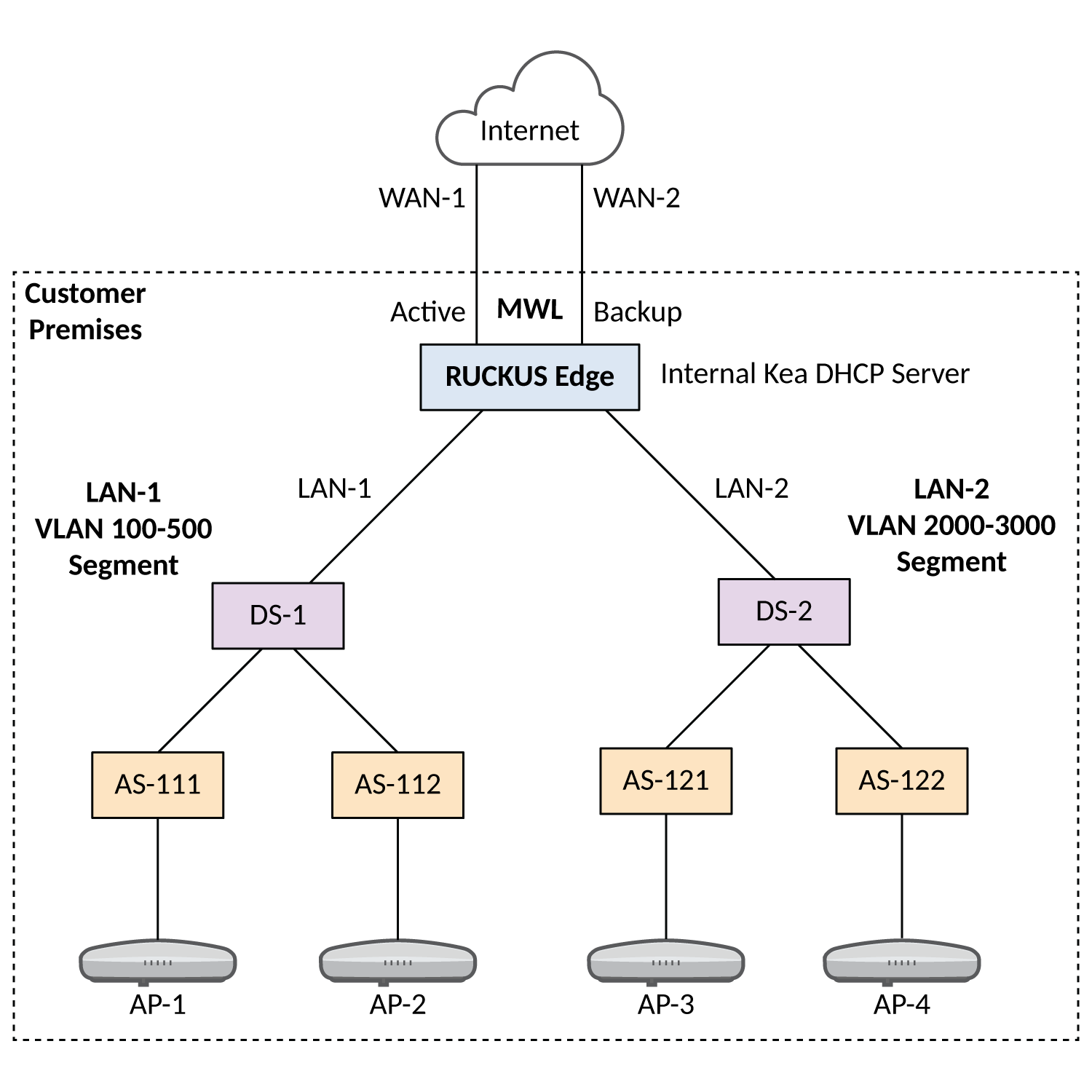
Topology 1: RUCKUS Edge Directly Connected to WAN (Single-WAN or Multi-WAN)
This is the recommended deployment model for RUCKUS Edge Gateway Service. In this topology, the RUCKUS Edge device connects directly to the WAN and provides Layer 3 gateway services for all configured VLAN segments. The WAN interface can obtain an IP address automatically through DHCP for seamless onboarding to RUCKUS One, or it can be configured with a static IP address if DHCP is not available.
The deployment supports both single-WAN and active-backup Multi-WAN configurations. In a Multi-WAN (MWL) deployment, the RUCKUS Edge node uses multiple ISP connections, allowing the secondary WAN link to automatically assume traffic forwarding responsibilities if the primary WAN link becomes unavailable. This provides improved WAN resiliency and uninterrupted access to cloud management services.
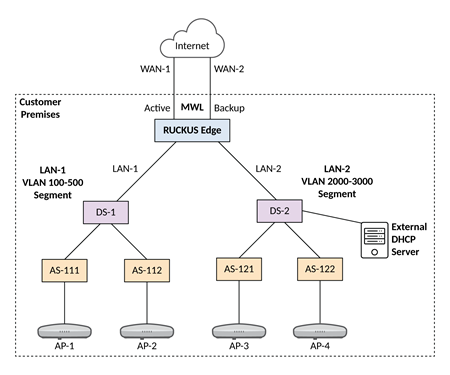
To onboard the remaining network infrastructure, VLAN segmentation and DHCP services must be configured on the RUCKUS Edge device. DHCP services can be provided either by the internal ISC Kea DHCP server hosted on the device or by an external DHCP server reachable through the LAN network. After deployment, APs and client devices receive IP addresses from the configured DHCP service and can successfully onboard and communicate through the RUCKUS Edge gateway.
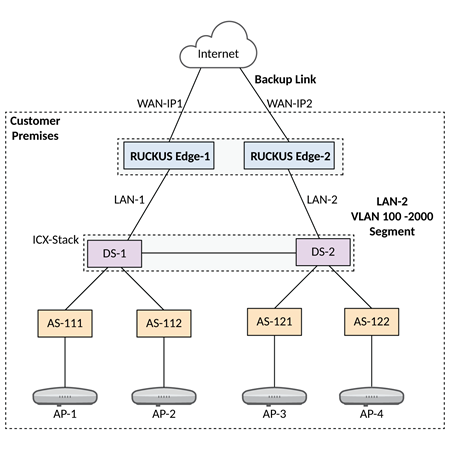
Topology 2: RUCKUS Edge Directly Connected to WAN with High Availability (Two-Node Cluster)
This deployment model provides node-level high availability by deploying two nodes as an active-backup cluster. Similar to the direct WAN deployment model, each node connects directly to the WAN and obtains an IP address through DHCP or manual configuration, allowing both nodes to onboard to RUCKUS One. Each node requires its own WAN IP address to maintain independent connectivity to management and cloud services.
High availability relies on the Virtual Router Redundancy Protocol (VRRP), which operates between the two nodes. VRRP elects one node as the active (master) gateway and the other as the standby (backup) gateway. The active node provides Layer 2 bridging, Layer 3 gateway, and WAN connectivity services for all configured VLAN segments, while the standby node maintains synchronized configuration and remains available to assume gateway responsibilities if a failure occurs. The standby node continues to communicate with RUCKUS One through its WAN connection but does not actively forward VLAN segment traffic. In the event of a failure, VRRP automatically transitions the backup node to the active role, restoring gateway services and traffic forwarding for the network.
To onboard the remaining network infrastructure, VLAN segmentation and DHCP services must be configured on the RUCKUS Edge cluster. DHCP services can be provided by either the internal DHCP server or an external DHCP server reachable through the LAN network. Once deployment is complete, connected APs and client devices receive IP addresses from the configured DHCP service and can successfully onboard and access network resources through the active RUCKUS Edge gateway.
Local Layer 2 traffic is managed by the underlying wired network infrastructure, while the nodes operate as transparent bridges for xSTP BPDUs to support loop prevention and network convergence. To reduce control-plane traffic and improve scalability, RUCKUS recommends using MSTP or grouped STP instances instead of configuring a separate STP instance for each VLAN. For proper high-availability operation, xSTP must be configured on the VRRP transport VLAN, and segment-to-port associations must be consistent across both devices.
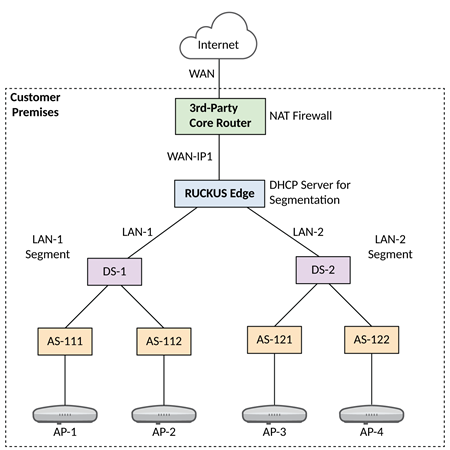
Topology 3: RUCKUS Edge Connected Through an Upstream Core Router
This deployment model is intended for environments where a core switch or router already provides WAN connectivity and Internet access. In this topology, the device connects to the existing core infrastructure and uses the core router as its next-hop gateway for external connectivity. The RUCKUS Edge WAN interface is configured within the same subnet as the core router, enabling the RUCKUS Edge device to establish connectivity to RUCKUS One for onboarding and management.
The RUCKUS Edge device continues to provide VLAN segmentation, Layer 3 gateway services, and DHCP services for downstream wired and wireless networks. DHCP services can be hosted on the device or provided through an external DHCP server, allowing APs and client devices to obtain IP addresses and onboard successfully once the deployment is complete. Unlike the direct WAN high-availability deployment model, Active-Backup RUCKUS Edge clustering is not supported when the device is deployed behind an upstream core router.
In this architecture, network segmentation traffic from APs and wired clients is routed through the core router for WAN access. The upstream router performs NAT and can also enforce firewall and security policies before forwarding traffic to external networks. To ensure return traffic is routed correctly, static routes for VLAN segment subnets must be configured on the core router to direct traffic back to the RUCKUS Edge gateway.
East-West Layer 2 traffic is handled by the underlying wired infrastructure, while the device transparently forwards xSTP BPDUs to support loop prevention and network convergence. To reduce control-plane overhead and improve scalability, RUCKUS recommends using MSTP or grouped STP instances instead of configuring separate STP instances for each VLAN.