Campus Fabric
Campus Fabric creates a more scalable architecture based on IEEE 802.1BR standards. RUCKUS Campus Fabric architecture adds ICX 7450, ICX 7250, or ICX 7150 devices configured as port extenders (PEs), or PE units, to a set of ICX 7650, ICX 7750, or ICX 7850 stack units configured as the control bridge (CB). The CB stack must contain units of the same model family but can contain different stackable SKUs for that model family.
The CB provides a single point of management for the extended network. Active and standby controller functions are retained and continue to provide hitless recovery as well as extended administrative functions. Campus Fabric greatly increases the number of access devices that the network can support. The distributed CB at the center of Campus Fabric architecture manages PE units and hundreds to thousands of ports at the network edge.
PE units are standards-based devices. Typically lower in cost, PE units rely on the CB for most network functions. As the network expands, new PE units can be detected and added to the network automatically using defined Campus Fabric communication protocols. PE units also inherit Premium-license features from the CB, which further reduces cost.
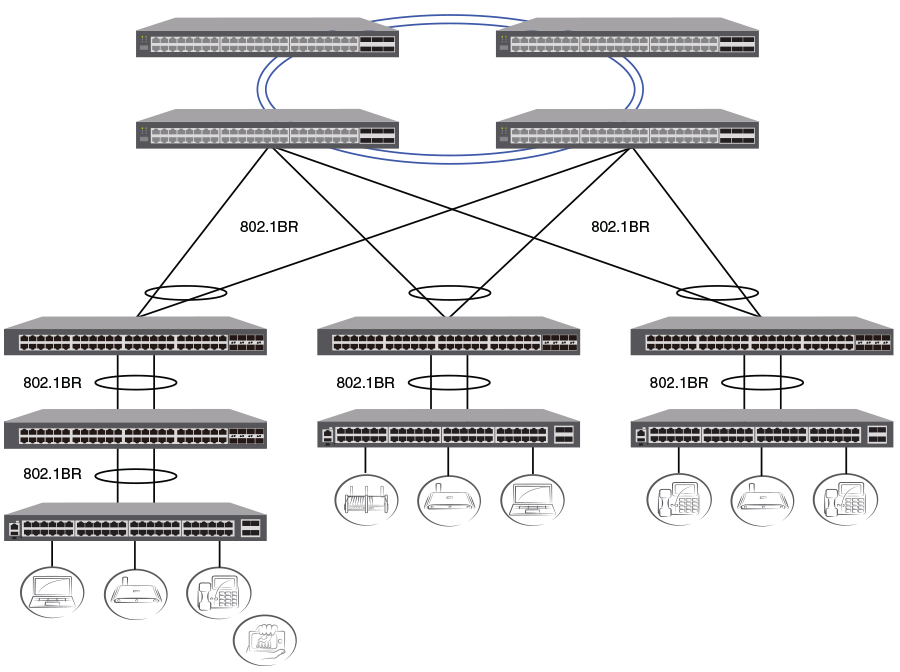
Campus Fabric architecture simplifies network management by unifying core, aggregation, and access functions. As illustrated in the following figure, a core stack (distributed chassis) serving as the CB connects to downstream Campus Fabric (PE) units that aggregate large numbers of access devices.
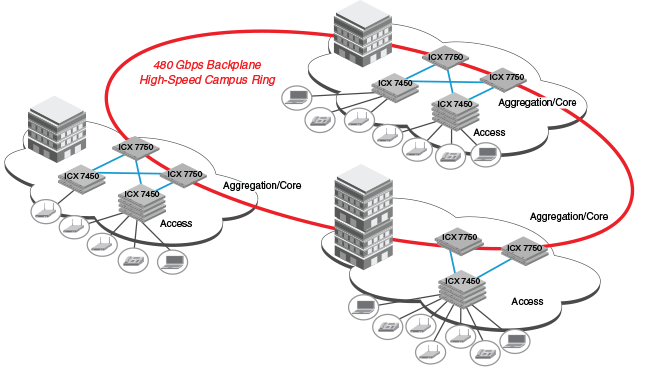
The following figure depicts three separate campuses, each with its own Campus Fabric domain, interconnected with a high-speed backbone.