VSRP Overview
Virtual Switch Redundancy Protocol (VSRP) is a RUCKUS proprietary protocol that provides redundancy and sub-second failover in Layer 2 and Layer 3 mesh topologies. Based on RUCKUS Virtual Router Redundancy Protocol Extended (VRRP-E), VSRP provides one or more backups for a VSRP-aware device. If the master device becomes unavailable, one of the Backup devices takes over as the Master device and continues forwarding traffic for the network. For more information regarding VRRP-E, refer to the RUCKUS FastIron Layer 3 Routing Configuration Guide.
RUCKUS switches support full VSRP as well as VSRP-awareness. A RUCKUS device that is not itself configured for VSRP but is connected to a RUCKUS device that is configured for VSRP, is considered to be VSRP-aware.
You can use VSRP for Layer 2, Layer 3, or for both layers. On Layer 3 devices, Layer 2 and Layer 3 share the same VSRP configuration information.
The following illustration displays an example of a VSRP configuration.
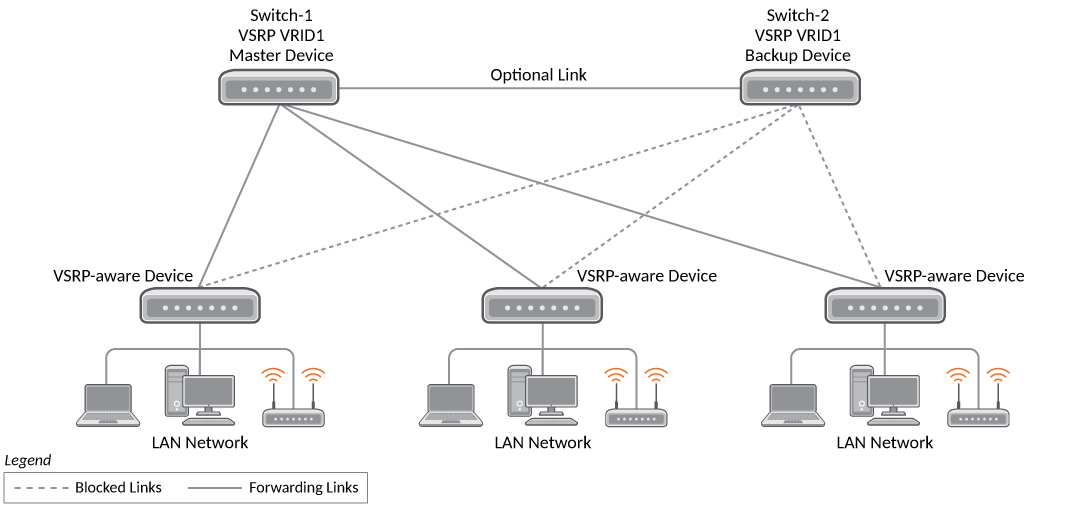
RUCKUS devices are configured as redundant paths for VRID 1. On each of the devices, a Virtual Router ID (VRID) is configured on a port-based VLAN. Since VSRP is primarily a Layer 2 redundancy protocol, the VRID applies to the entire VLAN. However, you can selectively remove individual ports from the VRID if needed.
Following Master election (described below), one of the RUCKUS devices becomes the Master for the VRID and sets the state of all the VLAN ports to Forwarding. The other device is a Backup and sets all the ports in its VRID VLAN to Blocking.
If a failover occurs, the Backup becomes the new Master and changes all its VRID ports to the Forwarding state.
Other RUCKUS devices can use the redundant paths provided by the VSRP devices. In this example, three RUCKUS devices use the redundant paths. A RUCKUS device that is not itself configured for VSRP but is connected to a RUCKUS device that is configured for VSRP, is VSRP-aware. In this example, the three RUCKUS devices connected to the VSRP devices are VSRP-aware. A RUCKUS device that is VSRP-aware can failover its link to the new Master in sub-second time by changing the MAC address associated with the redundant path.
When you configure VSRP, make sure each of the VSRP-aware RUCKUS devices has separate link to each of the VSRP devices.
The illustration (Fig 1: VSRP Topology) does not label which two devices are the RUCKUS devices referenced in this sentence, nor is there a VRID 1 label showing which devices are part of VRID 1.