MCT Peer as Intermediate Upstream Router
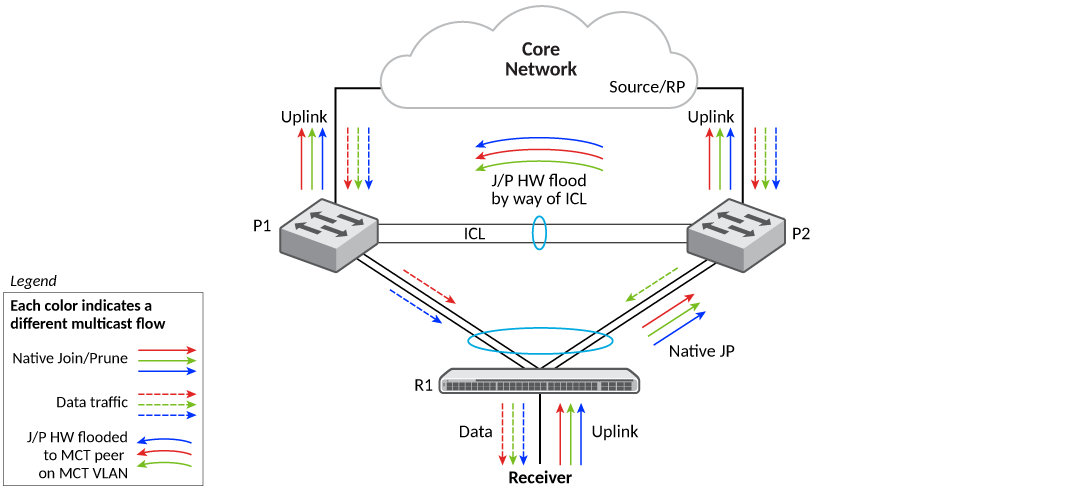
P1 and P2 are the MCT peers and are acting as upstream routers for R1. R1 is the last-hop
router (LHR).
P1, P2, and R1 are configured with PIM on the MCT virtual Ethernet (VE) interface. Rendezvous Point (RP) and source are in the core and the connectivity to the core is by way of an uplink.
Hello Exchange and Neighbor State
- In MCT topology, the CCEP links going out of P1 and P2 to R1 are treated as a single LAG at R1. When R1 sends multicast packets (either control or data packets), they reach only one of the peers. These control packets (hellos, joins, prunes, and others) received by one peer are flooded on the MCT VLAN including the ICL port to the other peer.
- Hellos sent by R1 can reach either P1 or P2 due to nature of the MCT LAG.
- Hellos that reach P2 are sent to P1 natively over ICL. P1 learns about R1 (by searching the source-MAC address of the hello packet in its MAC table), and it treats the hello as if it was received on its CCEP interface. Thus, both P1 and P2 learn about the PIM neighbors across the CCEP links and create a neighbor state for R1.
- Hellos originating from P1 and P2 are flooded on the MCT VLAN (for example on the ICL, CEP, and local CCEPs). This enables R1 to learn that both the MCT peers are PIM neighbors and also enables P1 and P2 to learn about each other as PIM neighbors on an ICL link and create a neighbor state for each other.
Join or Prune Exchange and Mcache State
- Because receivers are connected to R1, R1 creates the *,G state and sends a join state toward the RP and sends it on the MCT LAG. This join, like any other packet, is received by only one of the MCT peers.
- If P2 receives the *,G join natively, the join is processed or consumed and flooded to P1 over the ICL.
- P1 processes the join received over the ICL as if it is received on the CCEP.
- Both P1 and P2 create the *,G state with the CCEP as the OIF.
- Both the peers send the *,G join toward the RP, and both the peers pull the traffic.
- When the traffic arrives, the S,G state is created on both the peers, but only one of them forwards the traffic based on the software hashing algorithm.