Geo Redundancy
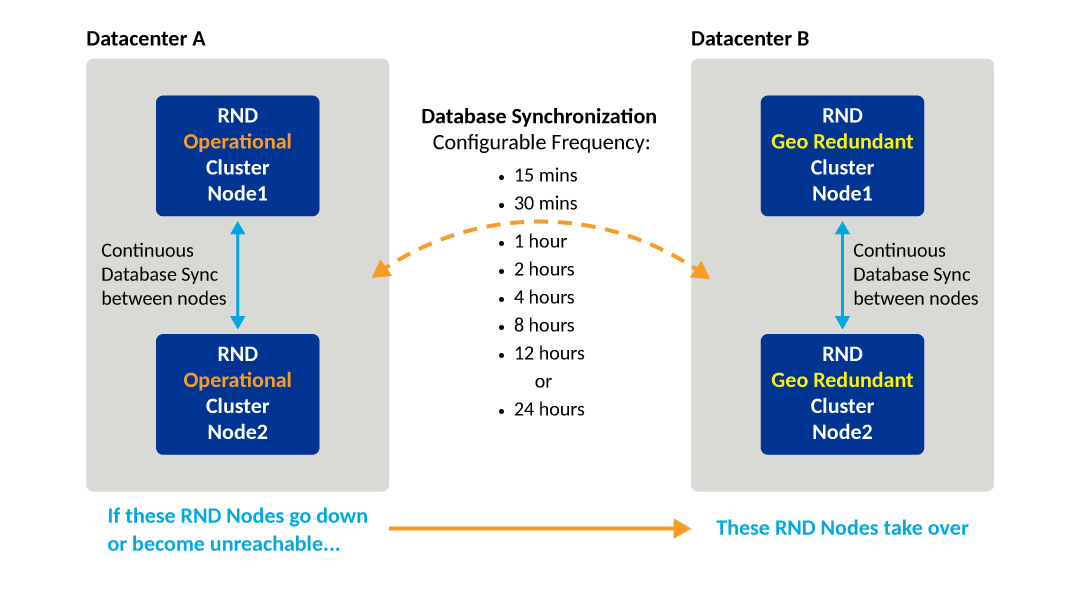
This capability ensures that if the operational (primary) data center experiences a failure, the cluster in the geo-redundant (secondary) data center can seamlessly take over. This helps to maintain uninterrupted network operations across distributed environments. The Geo Redundancy feature supports bidirectional synchronization, allowing both data centers to manage redundancy settings while enforcing a single configuration for consistency.
How It Works
Geo Redundancy in RND establishes a synchronized relationship between an operational cluster in one data center and a geo-redundant cluster in another geographically distinct location. The operational cluster continuously replicates its database to the geo-redundant cluster at scheduled intervals, ensuring that both clusters remain updated with the latest network configurations and inventory. Bidirectional synchronization allows either data center to detect changes and log them for periodic updates to maintain alignment between the clusters. This synchronization process is facilitated through direct database synchronization between the clusters, ensuring data integrity and consistency.
Synchronization operations for Geo Redundancy are managed automatically at a predefined frequency (Total Sync Duration) to maintain consistent data alignment between data centers, including periodic incremental syncs and a daily full sync. Only one redundancy setup is permitted at any time, providing control over the redundancy configuration. In the event of a failure in the operational cluster, such as hardware issues, connectivity loss, or a data center outage, the geo-redundant cluster automatically takes over, ensuring uninterrupted network management.
Requirements
- All nodes in both clusters must run the same RND software version and have the same IP mode.
- Secure database connectivity between data centers is mandatory for sync operations.
- Ports 5432 and 9999 must be open to establish a connection between the clusters in both data centers and to facilitate database synchronization between them.
Considerations
- Only one geo redundancy configuration can be active at any given time, maintaining data consistency and avoiding conflicts between the data centers.
- The geo redundancy setup supports only IPv4, and configurations using other IP modes are not compatible.
- The scope of synchronization includes alarm configurations and inventory data, such as SmartZone clusters and APs added to RND, and AP Registration Rules, including AP models, IP/subnet rules, and default registration rules. AP serial rules are synchronized through SmartZone imports, ensuring uniform rule application across both RND clusters.
- Certain administrative settings are not synchronized between clusters, resulting in each RND cluster retaining its own independent configurations. These unsynchronized settings include administrative activities, API tokens, application logs, licenses, and system settings.
Best Practices
This feature has no special recommendations for feature enablement or usage.
Prerequisites
This feature has no prerequisites to feature enablement or usage.