L3 Roaming
Feature Overview
L3 Roaming operates by dynamically establishing a DP-to-DP GRE tunnel between the visited DP and home DP when a client roams. The system manages ARP and User Equipment (UE) tables to track client mobility and uses defined timeout values for ARP entries, UE entries, and bridge entries. All client-originated packets (ARP, DHCP, IPv4 data) are forwarded back across the DP-to-DP tunnel to the home DP for processing. Only IPv4 is supported for L3 Roaming tunnels.
L3 Roaming Architecture Example
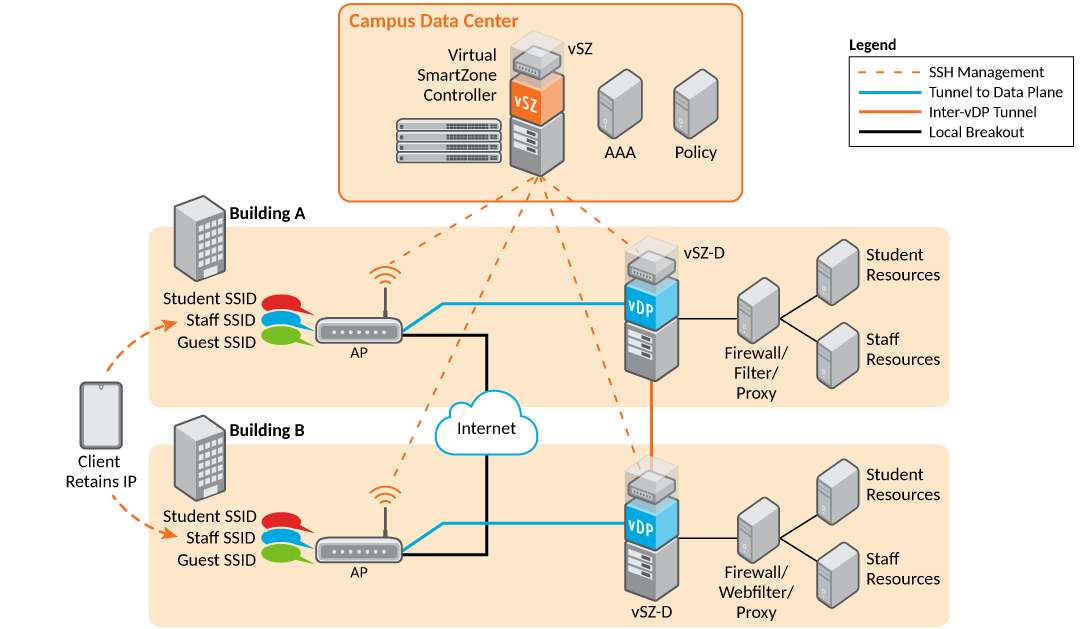
Each vSZ-D can be configured to provide DHCP services and perform Network Address Translation (NAT) for client traffic, or to operate as a DHCP relay. When a client roams from an AP in Building A to an AP in Building B, the vSZ-D in Building B detects the roaming event and forwards the client’s traffic to the home vSZ-D in Building A. A key benefit of this architecture is that roaming clients continue to access their home network resources, even when moving between buildings or subnets.
L3 Roaming with Multiple Data Planes illustrates a campus deployment with two buildings, each with a local vSZ-D. APs in each building tunnel WLAN traffic to the local vSZ-D. When a client roams between buildings, the visited vSZ-D anchors traffic back to the home vSZ-D through the DP-to-DP tunnel, preserving the client’s IP address and session continuity.
Requirements
- Supported controllers: SmartZone vSZ-H and vSZ-E
- Supported Data Plane types: vSZ-D, SZ100-D, SZ144-D
- L3 Roaming requires a valid feature license; for details, see Tunnel and Data Plane Licenses.
Considerations
- L3 Roaming is designed for large, multi-subnet environments, such as campuses, distributed enterprises, and hospitality or education deployments
- Timeout values for ARP, UE, and bridge entries are critical for maintaining session continuity, especially for devices that require persistent connections
- Tunnel encryption can be enabled for additional security; enabling encryption may impact throughput
- The system supports MTU discovery and on-the-fly packet fragmentation to optimize tunnel throughput
Limitations
Best Practices
The following best practices are recommended for enabling and using L3 Roaming:
- Plan DP and zone assignments to ensure that no more than 40 DPs are registered in a cluster when L3 Roaming is required
- Regularly review and adjust timeout values for ARP, UE, and bridge entries to optimize session continuity for all device types
- Enable tunnel encryption if additional security is required, and monitor throughput to assess the impact
- Use DHCP and NAT services on vSZ-D to improve IP assignment and network flexibility in large deployments
Prerequisites
The following prerequisites must be met before enabling or configuring L3 Roaming:
- Ensure that the cluster contains 40 or fewer registered DPs
- Purchase and activate a valid L3 Roaming feature license; for more information, see Tunnel and Data Plane Licenses.