Network Time Protocol Version 4 Overview
The NTPv4 feature synchronizes the local system clock in the device with the Coordinated Universal Time (UTC). The synchronization is achieved by maintaining a loop-free timing topology computed as a shortest-path spanning tree rooted on the primary server. NTP does not know about local time zones or daylight-saving time. A time server located anywhere in the world can provide synchronization to a client located anywhere else in the world. It allows clients to use different time zone and daylight-saving properties. Primary servers are synchronized by wire or radio to national standards such as GPS. Timing information is conveyed from primary servers to secondary servers and clients in the network. NTP runs on UDP, which in turn runs on IP.
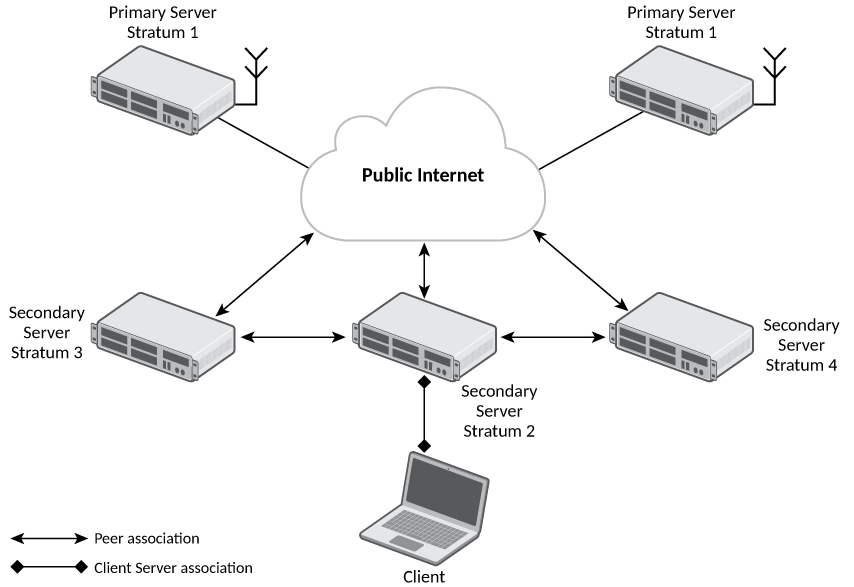
NTP has a hierarchical structure. NTP uses the concept of a stratum to describe how many NTP hops away a machine is from an authoritative time source. A stratum 1 time server typically has an authoritative time source such as a radio or atomic clock, or a Global Positioning System (GPS) time source directly attached. A stratum 2 time server receives its time through NTP from a stratum 1 time server and so on. As the network introduces timing discrepancies, lower stratum devices are a factor less accurate. A hierarchical structure allows the overhead of providing time to many clients to be shared among many time servers. Not all clients need to obtain time directly from a stratum 1 reference, but can use stratum 2 or 3 references.
NTP operates on a client-server basis. The current implementation runs NTP as a secondary server and/or a NTP Client. As a secondary server, the device operates with one or more upstream servers and one or more downstream servers or clients. A client device synchronizes to one or more upstream servers, but does not provide synchronization to dependant clients. Secondary servers at each lower level are assigned stratum numbers one greater than the preceding level. As stratum number increases, the accuracy decreases. Stratum one is assigned to Primary servers.
NTP uses the concept of associations to describe communication between two machines running NTP. NTP associations are statistically configured. On startup or on the arrival of NTP packets, associations are created. Multiple associations are created by the protocol to communicate with multiple servers. NTP maintains a set of statistics for each of the server or the client it is associated with. The statistics represent measurements of the system clock relative to each server clock separately. NTP then determines the most accurate and reliable candidates to synchronize the system clock. The final clock offset applied for clock adjustment is a statistical average derived from the set of accurate sources.
When multiple sources of time (hardware clock, manual configuration) are available, NTP is always considered to be more authoritative. NTP time overrides the time that is set by any other method.
NTPv4 obsoletes NTPv3 (RFC1305) and SNTP (RFC4330). SNTP is a subset of NTPv4. RFC 5905 describes NTPv4.
To keep the time in your network current, it is recommended that each device have its time synchronized with at least four external NTP servers. External NTP servers should be synchronized among themselves to maintain time synchronization.
- NTP implementation conforms to RFC 5905.
- NTP can be enabled in server and client mode simultaneously.
- The NTP uses UDP port 123 for communicating with NTP servers/peers.
- NTP server and client can communicate using IPv4 or IPv6 address
- NTP implementation supports below association modes.
- NTP supports maximum of 8 servers and 8 peers. The 8 peers includes statically configured and dynamically learned.
- NTP can operate in authenticate or non-authenticate mode. Only symmetric key authentication is supported.
- By default, NTP operates in default VLAN and it can be changed.