Campus Fabric Roles and Communication Protocols
The control bridge (CB) creates, deletes, and manages port extender (PE) ports. It performs switching, routing, and forwarding for PE ports and provides centralized policy management.
The CB uses the Link Level Discovery Protocol (LLDP) to discover PE units. When the CB discovers a PE unit, it connects to the PE unit and creates a control plane using Control and Status Protocol (CSP) over the uplink/cascade port.
Each PE port is managed as a virtual port from the CB perspective. The CB sets up each PE unit for traffic forwarding and creates multicast and unicast forwarding tables through CSP.
The PE provides a data path between end hosts and the CB and uses LLDP to advertise 802.1br capabilities to the CB over the upstream port or LAG. If capabilities match, the PE uses CSP to attach to the CB. The PE reports the number of available ports to the CB, and the CB allocates an E-CID for each PE port. The PE also performs hardware-based multicast and broadcast replication.
As illustrated in the following figure, the access PE unit assigns an E-tag that is based on the configured ingress port to traffic forwarded upstream. E-tags provide downlink-to-uplink association. Transit PE units do not assign or change E-tags. PE downstream forwarding is based on the E-CID fields in the E-tags. The E-tag is removed by the access PE unit at the last hop downstream.
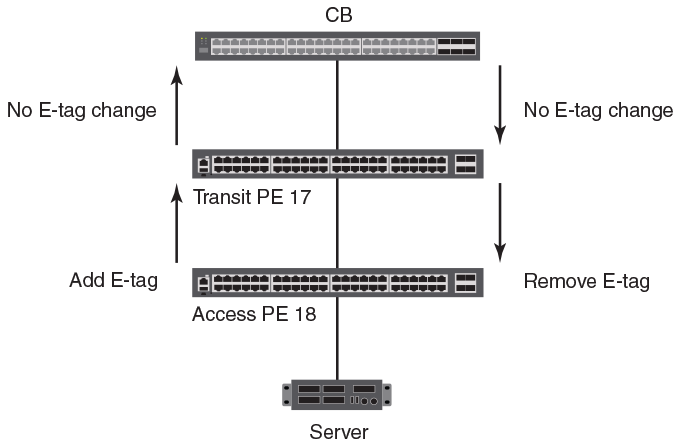
The bidirectional path between the external extended port and the corresponding internal extended port is referred to as an E-channel. E-channels are identified by the E-channel ID (E-CID) in the E-tag (channel range 0x00 0001 to 0x3F FFFE). E-channels can be point-to-point, point-to-multipoint, or multipoint-to-point.