Flexlink Overview
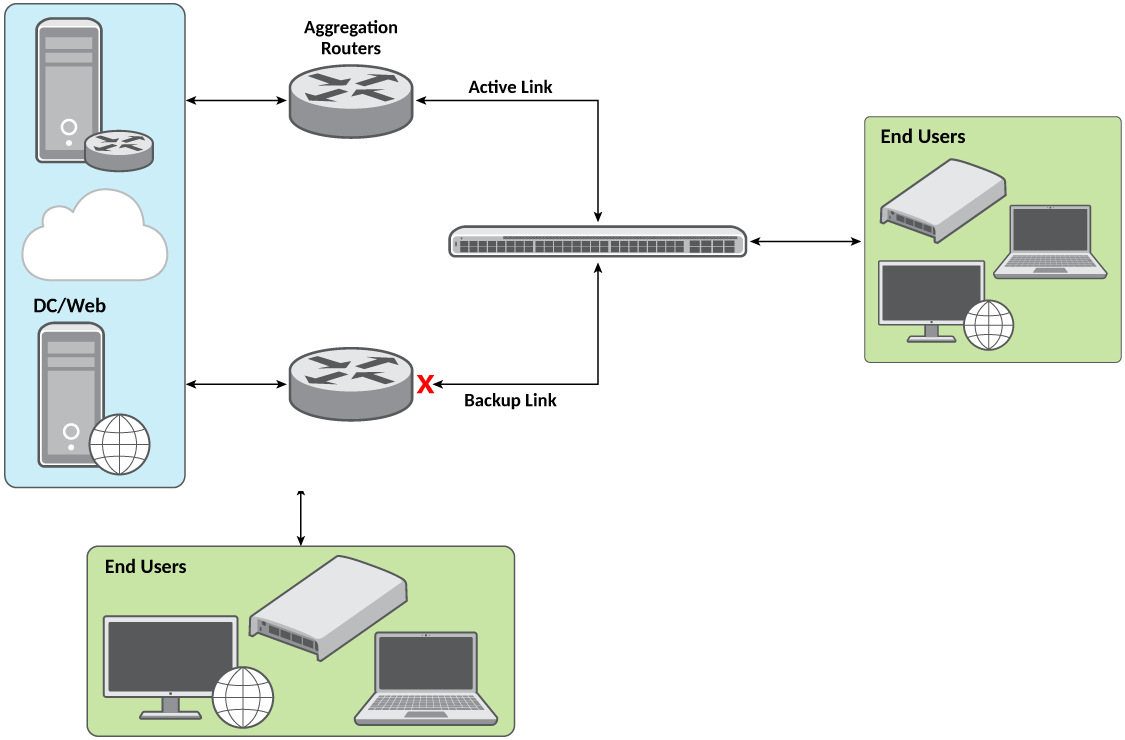
Flexlink is enabled on a pair of interfaces by configuring an interface as active link and other interface as backup link. The interfaces can be physical interfaces or LAG interfaces. When Flexlink instance is configured, spanning support is disabled on the interfaces configured as flexlinks and the no span configuration will show up as explicit interface configuration under those interfaces.
The interface under which Flexlink is enabled is automatically considered the active link. The active link forwards the network traffic and the backup link remains dormant. When the active link goes down, the backup link transitions to the active link state and begins forwarding the traffic. When the originally configured active link comes back up, it goes into backup mode and does not forward traffic. This default failover forwarding behavior can be changed by configuring a preemption mechanism, which allows you to specify the preferred port for forwarding traffic.
In a Flexlink configuration, traffic flows through the active link and all dynamic MAC entries are learned through the active link. Upon link failure, the MAC addresses learned on the active link are moved to the backup link for network packet forwarding because the backup link is set to the Forwarding state. At any given point of time, only the active link forwards the traffic. The Flexlink interfaces (both the active link and backup link) must be physically up to ensure expected failover forwarding behavior. No configuration is required on the peer switch or backup interface for Flexlink to work.
Preemption
Flexlink preemption is a mechanism that allows you to specify the preferred interface for forwarding traffic. That is, you can define the criteria for preempting the current active interface by the other interface when it comes back up after a failover. This is done by configuring the following preemption modes:
By default, the preemption mode is "off", that is no preemption will take place. When active link fails, backup will take over and forward the traffic.
- Forced: The preemption forced mode always provides precedence to the configured active interface to forward the traffic. When the link status of the configured active interface comes up after the failover, it preempts the current active link (configured backup interface) and takes over traffic forwarding.
- Bandwidth: The preemption bandwidth mode preempts the Flexlink link that has lesser bandwidth and chooses the interface with higher bandwidth as the active link.
Preemption Delay
A preemption delay can be set to postpone the preemption of the current active link by the backup link according to the configured preemption mode. That is, you can set a time delay (in seconds) before allowing the backup link to preempt the current active interface and take over traffic again. The preemption delay helps to avoid frequent active-to-backup switchover. Preemption delay configuration is applicable only for forced and bandwidth preemption modes. Preemption delay configuration and the preemption mode off are mutually exclusive.