MVR Overview
MVR configuration involves creation of a dedicated multicast VLAN (MVLAN) specifically for multicast traffic distribution. This multicast VLAN becomes the MVR source VLAN to which a range of multicast group addresses is assigned. You can configure other VLANs to be MVR receiver VLANs that receive multicast streams from the MVLAN. It is through the single dedicated MVLAN that multicast traffic from the source flows throughout the Layer 2 network while subscribers remain in separate VLANs. When deployed, each device that receives a multicast stream from the MVLAN checks each multicast group address assigned to it and forwards the multicast VLAN traffic to a particular receiver VLAN. You can configure multiple MVLANs on a device, but they must have disjointed multicast groups. An MVR receiver VLAN gets associated dynamically to more than one MVLAN according to the multicast group address.
There are two types of MVR ports:
- MVR Source Port (SP): The port to which the multicast traffic flows using the MVLAN. The source port must be in the MVLAN.
- MVR Receiver Port (RP): The port where a listening host is connected to the switch. Receiver ports can be in different VLANs except the MVLAN.
MVR-enabled devices selectively forward IPTV multicast traffic from interfaces on the MVLAN (source ports) to host interfaces in other VLANs designated as MVR receiver ports. MVR receiver ports can receive traffic from source ports on the MVLAN but cannot send traffic to the MVLAN. The receiver ports remain in their own VLANs for bandwidth and security reasons.
MVR assumes that subscriber ports subscribe and unsubscribe (join and leave) these multicast streams by sending out IGMP join and leave messages.
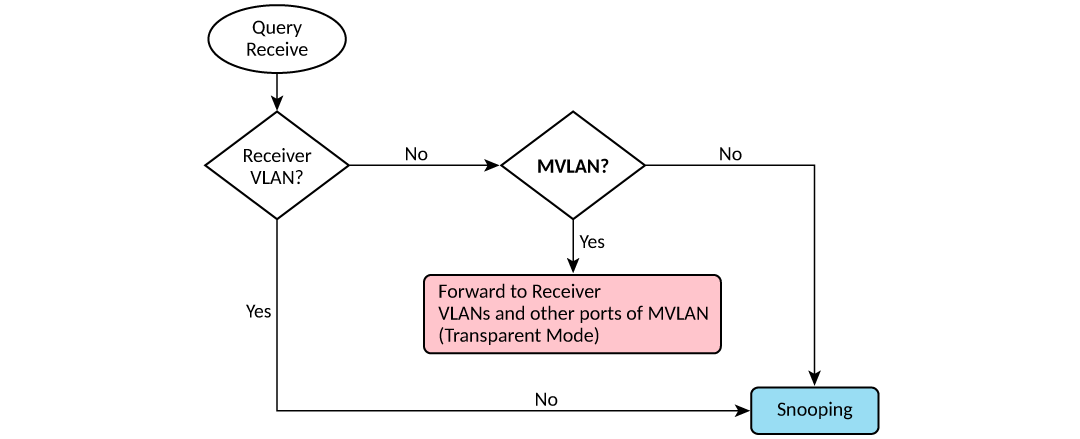
VLAN enabled MVR handles IGMP messages for the following processes:
- Reports/Leaves
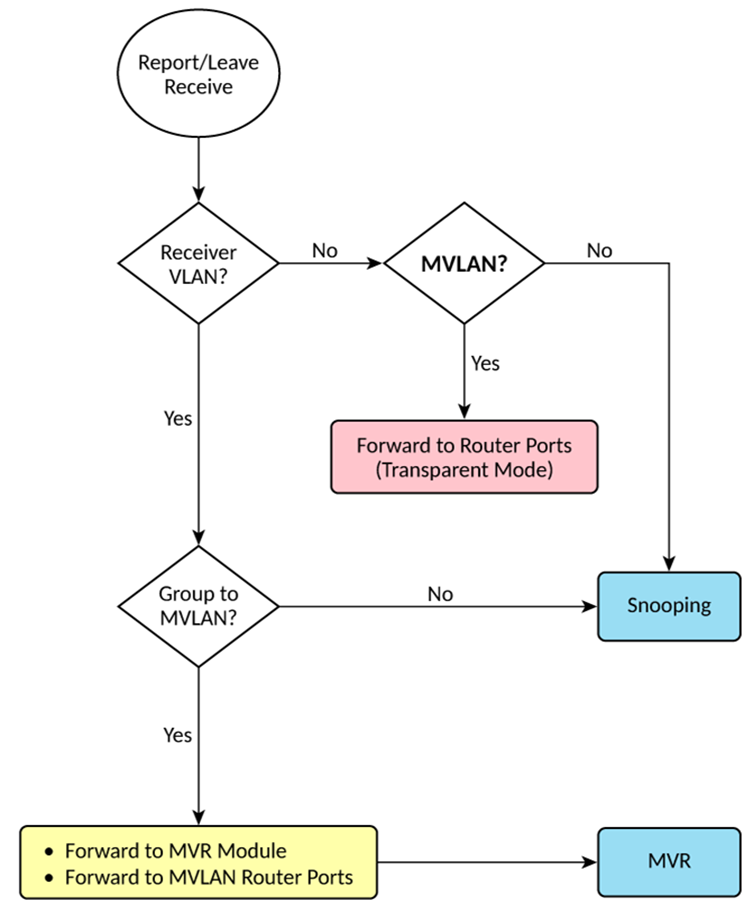
The following flowchart captures modification in Reports/Leaves processing for MVR-enabled VLANs. Groups that belong to the MVLAN are processed in the MVLAN context only if received from receiver ports.
Note: The MVLAN is in transparent mode. Reports are transparently forwarded, and are not used to learn group membership in the source VLAN. - Query
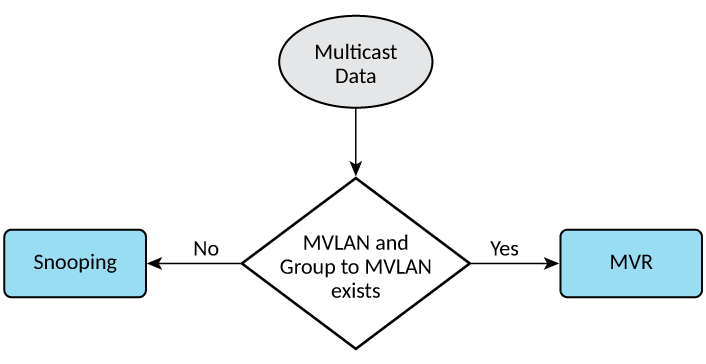
- Multicast Data
Note: By default, multicast data is only forwarded to router ports. Source ports that are not router ports must be manually configured as router ports to be included in the forwarding of multicast data.