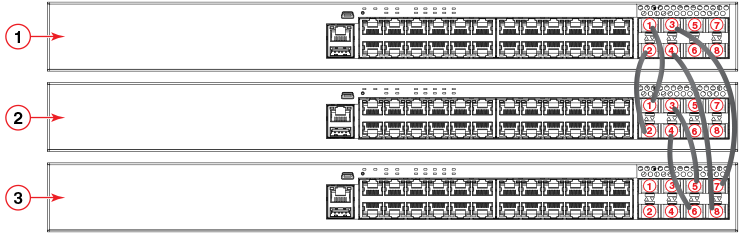
Stacking topologies for a traditional stack
Both linear and ring topologies are supported in a traditional stack. In a linear stack topology there is a connection between each switch that carries two-way communications across the stack. The physical connection between the devices can use one port (stacked-port) or two ports (stacked-trunk) per trunk. The stack uses a pair of ports (n, n+1, where n is odd and ranges from 1 through 7) even if there is only one physical connection between the devices in a stack. The physical connections must be from an odd-numbered port to an odd-numbered port or an even-numbered port to an even-numbered port.
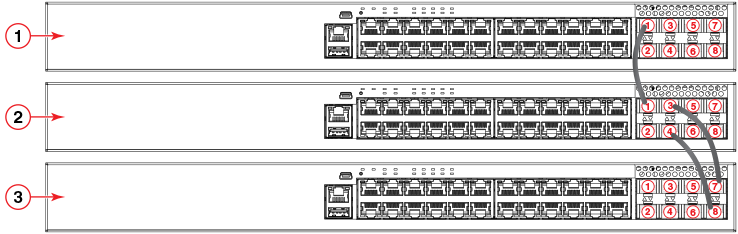
The following figure shows a linear stacking topology example.
- For the first device in the stack, ports (1/2/1, 1/2/2) are being used as stacked ports.
- For the second device in the stack, ports (2/2/1, 2/2/2 and 2/2/3, 2/2/4) are being used as stacked ports.
- There is a single physical connection between device 1 and device 2 in the stack, ports 1/2/1 and 2/2/1 (odd-numbered port to odd-numbered port). This is a stacked-port configuration.
- There are two physical connections between device 2 and device 3 in the stack. Port 2/2/3 is connected to port 3/2/7 (odd-numbered port to odd-numbered port) and port 2/2/4 is connected to 3/2/8 (even-numbered port to even-numbered port). This is a stacked-trunk configuration.
In a ring stacking topology, there is an extra connection between the logical first and last devices, forming a "ring" or "closed-loop." The closed-loop connection provides a redundant path for the stack link, so if one link fails, stack communications can be maintained.