IPv6 PIM Sparse
IPv6 Protocol Independent Multicast (PIM) Sparse is supported. IPv6 PIM Sparse provides multicasting that is especially suitable for widely distributed multicast environments.
In an IPv6 PIM Sparse network, an IPv6 PIM Sparse router that is connected to a host that wants to receive information for a multicast group must explicitly send a join request on behalf of the receiver (host).
In this section:
- Layer 3 IPv6 Multicast Scaling Numbers
- IPv6 PIM Sparse Router Types
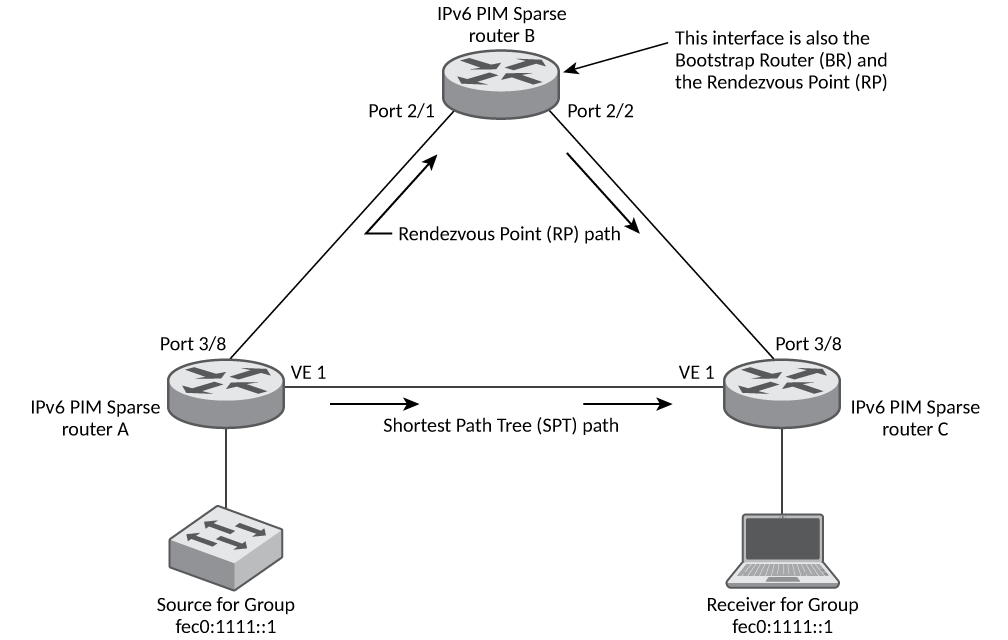
- RP Paths and SPT PathsIn a typical IPv6 PIM Sparse domain, there may be two or more paths from a designated router (DR) for a multicast source to an IPv6 PIM group receiver.
- RFC 3513 and RFC 4007 Compliance for IPv6 Multicast Scope-based Forwarding
- IPv6 PIM Sparse Configuration
- Enabling IPv6 PIM SparseIPv6 PIM must be enabled globally and IPv6 PIM Sparse Mode (PIM SM) enabled locally on specific interfaces.
- Enabling IPv6 PIM Sparse on a Virtual Ethernet InterfaceIPv6 PIM must be enabled globally and IPv6 PIM Sparse Mode (PIM SM) enabled locally on specific interfaces.
- Enabling IPv6 PIM Sparse on a Specific VRFIPv6 PIM must be enabled globally and IPv6 PIM Sparse Mode (PIM SM) can be enabled for a specific virtual routing and forwarding instance (VRF).
- Modifying IPv6 PIM OptionsMany IPv6 PIM options can be modified from their default values in IPv6 PIM router configuration mode.
- Configuring the Slow Path Forwarding of IPv6 Multicast Data PacketsThe slow path forwarding of IPv6 multicast data packets is enabled by default. Various commands can be used to change the default settings for the slow path forwarding of IPv6 multicast data packets.
- Configuring BSRs and RPs for IPv6 PIM SparseAfter enabling IPv6 PIM SM globally and locally, you need to identify an interface on at least one device as a candidate IPv6 PIM Sparse Bootstrap Router (BSR) and candidate IPv6 PIM Sparse rendezvous point (RP).
- Configuring BSRs and RPs for IPv6 PIM Sparse for a Specified VRFAfter enabling IPv6 PIM SM globally and locally, you need to identify an interface on at least one device as a candidate IPv6 PIM Sparse Bootstrap Router (BSR) and candidate IPv6 PIM Sparse rendezvous point (RP). You can configure BSRs and RPs for a virtual routing and forwarding (VRF) instance.
- harp://6a7214064c282d8ad6c44b90/pr/ORIGINAL/RUCKUS%20FastIron%20IP%20Multicast%20Configuration%20Guide_v10_GUID-572B4C1E-CC03-4A11-81B3-37B076709BBE/Updating%20IPv6%20PIM-Sparse%20Forwarding%20Entries%20with%20New%20RP%20Static%20Configuration=GUID-E931610D-FA53-4F80-AA50-6D6C5CA53CDA=2=en-US=.xml
- Embedded Rendezvous Point
- harp://6a7214064c282d8ad6c44b90/pr/ORIGINAL/RUCKUS%20FastIron%20IP%20Multicast%20Configuration%20Guide_v10_GUID-572B4C1E-CC03-4A11-81B3-37B076709BBE/Source-Specific%20Multicast%20with%20IPv6%20PIM=GUID-459F6BC5-7F8C-4F89-A53F-ECC7542F721B=3=en-US=.xml
- Configuring a DR Priority
- Passive Multicast Route Insertion
- Clearing the IPv6 PIM Traffic Counters and Forwarding Cache
- Defining the Maximum Number of IPv6 PIM Cache EntriesYou can define the maximum number of IPv6 PIM multicast cache entries.
- Configuring a Static Multicast Route Within
a VRFYou can configure a static multicast route within a virtual routing instance (VRF).
- Configuring the Route Precedence by Specifying the Route TypesPrecedence tables specify how routes are selected for multicast.
- Configuring IPv6 PIM Neighbor FilteringYou can configure an ACL and apply it to an interface to control neighbor access.
- IPv6 PIM Join and Prune PolicyThe IPv6 PIM Join and Prune Policy provides the capability for the following options to be configured:
Parent topic: IPv6 Multicast Protocols