Introduction
The RUCKUS ICX platform supports the RESTCONF protocol as defined in IETF RFC 8040. RESTCONF is a Hypertext Transfer Protocol (HTTP)-based protocol that uses Transport Layer Security (TLS) and provides a programmatic interface for accessing data defined in YANG, using the datastore concepts defined in the Network Configuration Protocol (NETCONF). RESTCONF is an IETF standard protocol, which is a successor of RESTful APIs and NETCONF and is used to configure and retrieve operational data on ICX. It is driven by YANG models that describe the configuration and operation of the ICX platform including validation rules and dependencies.
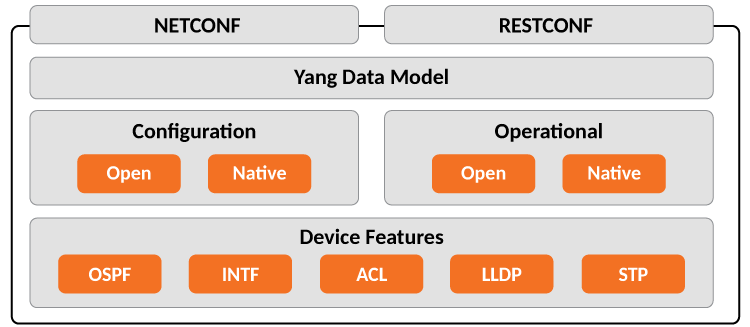
The following components make up the RESTCONF protocol stack:
NETCONF: Network Configuration Protocol (NETCONF) is a protocol used to manage networking devices like switches and routers. NETCONF uses Remote procedure calls (RPCs) to read, write configuration data into networking devices. Remote procedure calls use XML to send and receive configuration data from NETCONF management station to networking devices.
YANG: Yet Another Next Generation (YANG) is a data modeling language which can be used to send, receive and store data with network management protocols like RESTCONF and NETCONF. Yang is used to store both configuration and state of network elements.
REST: Representational state transfer (REST) is an API (Application programmer interface) used by web services. REST is a stateless client/server protocol uses http methods for requests between clients and servers. REST uses http methods for requests and responses with XLM or JASON for data encoding.
A Web server which uses REST APIs for client/server requests and responses is called RESTful.
RESTCONF: Is similar to REST API which is defined in RFC 8040. It is an HTTP-based protocol that provides a programmatic interface for accessing data defined in YANG, using the datastore concepts defined in NETCONF. As laid out in RFC 8040, "RESTCONF is an HTTP-based protocol that provides a programmatic interface for accessing data defined in YANG, using the datastore concepts defined in NETCONF."
Because RESTCONF uses an HTTP-based protocol to send and receive messages for networking devices, it has become a better option than NETCONF.
HTTP: Methods like GET, POST, PUT, DELETE, and so on, are used by REST/RESTCONF to send requests/responses. Organizations can use REST APIs to manage web services and RESTCONF to manage networking devices. Both use HTTP-based protocols, making it easy for operations and maintenance.
An external client can use XML or JSON YANG-based configurations to program the ICX platform configuration. The validation rules and dependencies described in the YANG model are useful to check user input even before sending the configuration request to the ICX platform. The data exchange format between clients and the ICX platform is JSON over a TLS/HTTP or HTTPS connection.
The OpenConfig working group has defined a common set of models to configure and operate network devices. The ICX utilizes the OpenConfig YANG model for its configuration and operation. The IETF has several YANG models which may be used when there is no model for a specific feature. An ICX custom model will be created if no standard-based models exist. YANG models will be deviated from and augmented to fit the ICX features and behaviors.
Refer tohttp://www.openconfig.net/projects/models/ for more information on the OpenConfig working group.