Creating an eDPSK Pool for Use With External DPSK
You can create eDPSK pools to associate with specific SSIDs in your environment.
- In the Cloudpath UI, go to Configuration > DPSK Pools.
- Click Create DPSK Pool.
- In the ensuing Create Pool screen, enter the information to create the pool, then
click
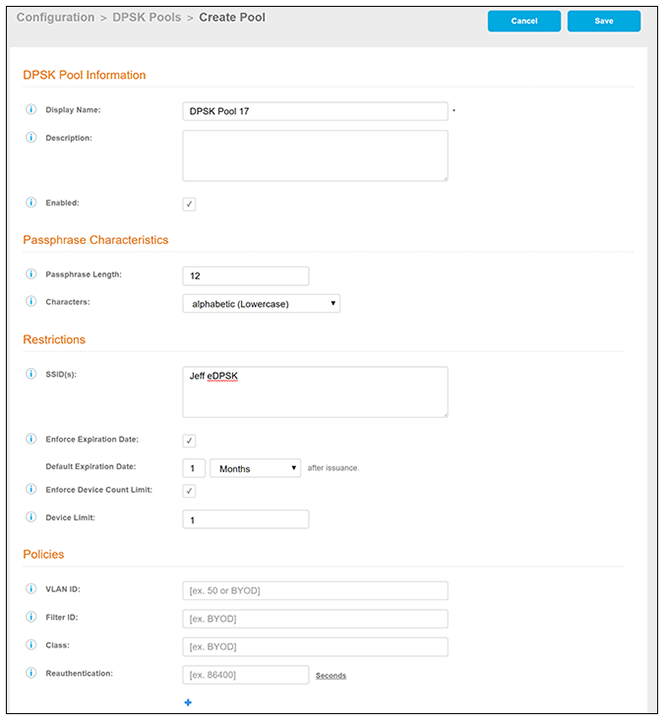
Save. The following screen shows an example and describes the fields.
- Display Name: The name of the eDPSK pool. This should be a descriptive name. It is visible only to Cloudpath administrators.
- Description: Optionally enter a description of this pool. It is visible only to Cloudpath administrators.
- Enabled: This box is checked by default. It must be checked for this DPSK pool to be used.
- Passphrase Length: This is the default length (in number of characters) for the pre-shared keys generated for this pool. The maximum length is 63.
- Characters: From the drop-down, select the types of characters that can be used for the pre-shared keys.
- SSID(s): Enter the specific SSID or SSIDs, separated by semi-colons, for which you want this pool to be used. Wildcard characters are not supported.
- Enforce Expiration Date: If checked, newly generated DPSKs will have an expiration date based on the creation date and the offset that you define in the "Default Expiration Date" popup box.
- Enforce Device Count Limit: If checked, each DPSK will be assigned a maximum device count as specified in the "Device Limit" popup box. If the "Enforce Device Count Limit:" box is un-checked, an unlimited number of devices can use the DPSK.
- VLAN ID: If this field is populated, the VLAN ID is included in the RADIUS reply to
the controller for successful authentications. Cloudpath sends Tunnel-Type, Tunnel-Medium-Type,
and Tunnel-Private-Group-ID. If your network policy is wireless, the Tunnel-Type value
is VLAN, the Tunnel-Medium-Type value is 802 (this includes all 802 media plus Ethernet
canonical format), and the Tunnel-Private-Group-ID is the integer that represents
the VLAN number to which group members will be assigned.
If the VLAN ID field is left blank, Cloudpath will not return a VLAN ID in the RADIUS reply; therefore the controller assigns the VLAN ID based on its own configuration.
Note: When you create a workflow to use eDPSK, you can include a step that prompts users to enter their VLAN ID. You can create this step to store the ID in a variable called LOCATION. Then, you would use ${LOCATION} as the default VLAN ID of the pool. - Filter ID: If this field is populated, the Filter ID is included in the RADIUS reply for successful authentications. If this field is left blank, Cloudpath will not return a Filter ID in the RADIUS reply.
- Class: If this field is populated, the Class is included in the RADIUS reply for successful authentications. If this field is left blank, Cloudpath will not return a Class in the RADIUS reply.
- Reauthentication: The number of seconds included in the RADIUS reply for successful authentications. If the device stays connected for longer than this period, the WLAN or switch requires that the device be reauthenticated. In wireless devices, this causes the encryption keys to rotate.
- Additional Attributes: You can add other attributes in the "Policies" section of the screen by clicking the + button, and selecting the desired fields and values. These attributes will be returned to the controller in an access-accept.
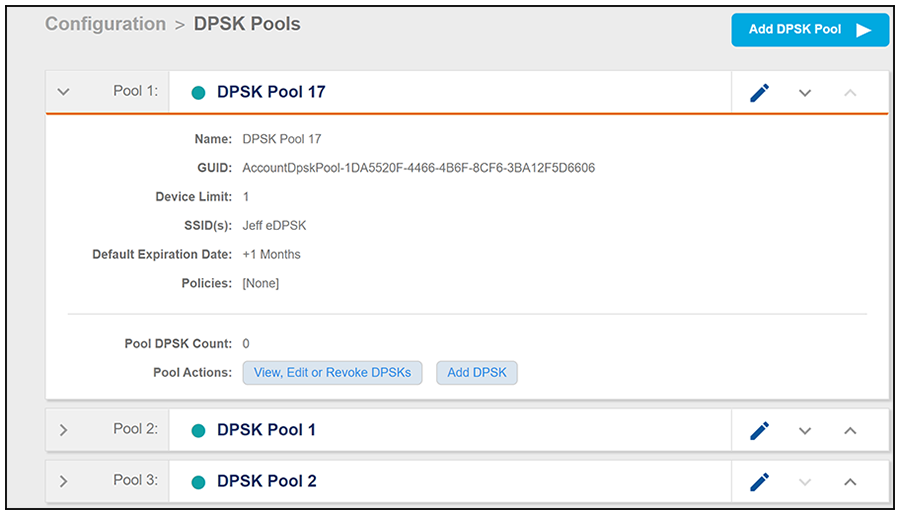
- After you save your configuration, you are returned to the main eDPSK Pools screen, where you can check the pool you just configured, as shown in the figure below: