Adding RADIUS Policies to the CA Certificate Template
You can add as many policies as you want,
but only one policy can be associated with a given user. For a user to successfully
connect
to the network, the user must be a match for at least one policy (or you can allow
users to
connect even if they do not match a policy).
Steps to Add Policies
Follow these steps to add a policy from the RADIUS Policies tab of a configured certificate template:
entire section new for 5.8
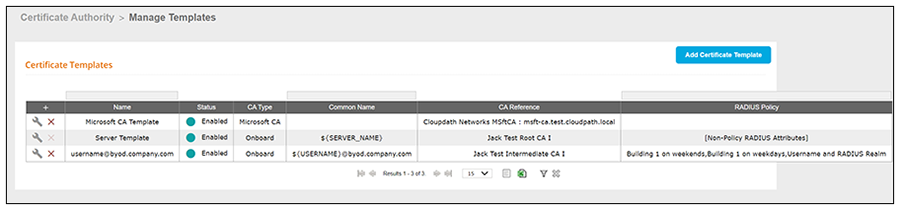
- If you are not already in the RADIUS Policies tab of a configured certificate template, go to Certificate Authority > Manage Templates to view all existing certificate templates:
- Click the wrench icon for the Microsoft CA template.
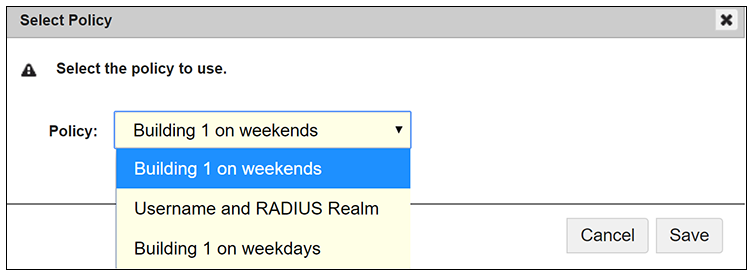
- In the ensuing screen, click the RADIUS Policies tab, then click Assign Policy. The Select Policy Drop-down list appears, as shown in the following example list. The policies that you have already configured are available for you to add:
- Select the policy you wish to add, then click Save.
- Continue to add policies as you desire. If you have added all available policies, you will receive the message: " All Defined Policies have been assigned."
Policy Rules
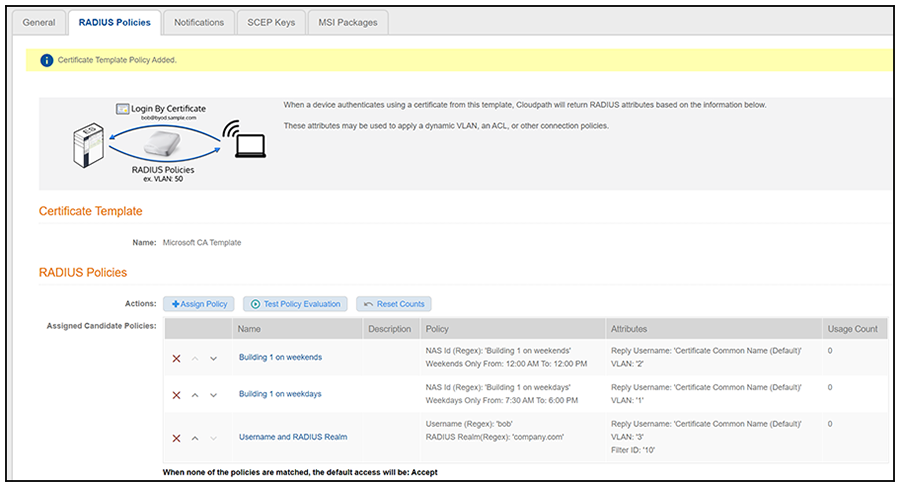
The following illustration shows an example of how the page appears after three policies have been added:
- There may be many policies whose
criteria are matched by a user, but the first policy that is a match is the one
that gets applied. For example, if you have three policies, as shown above, the
order in which you have them listed is the order in which they will be tested
for matches with an enrolling user.
Note: You can use the arrows in the screen show above to list the policies in the desired order. If you want to remove a policy from being used in the template, click the X next to the policy, then confirm the removal of the policy when prompted.
- Because the "Building 1 on weekends"
policy is listed first, the matching criteria in that policy (listed in the
Policy column) will first be checked against an enrolling user. If there is a
match, the policy is applied to the user (meaning that the attributes listen in
the Attributes column are applied to the user). If there is no match, the next
policy ("Building 1 on weekdays") is checked against the enrolling user, and so
on.
Note: If none of the policies match a specific user, the default access setting (configured when you create a certificate tempate) is used to either accept or reject the user. In the example above, at the bottom of the illustration, the default access it to accept the user because that is how the field was set when the certificate template was configured.