How Port-Based Fixed Rate Limiting Works
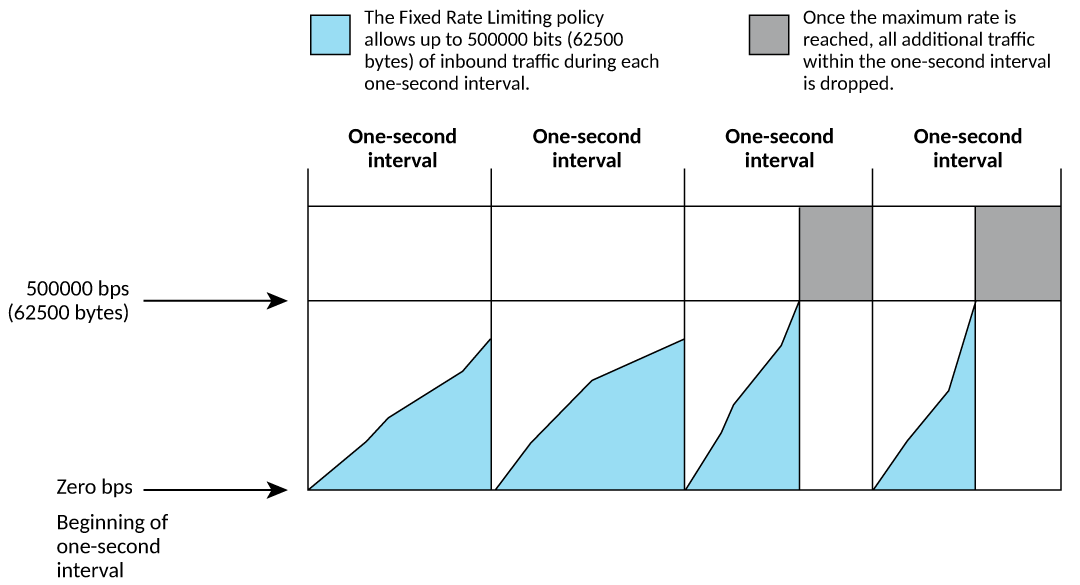
The following figure shows an example of how fixed rate limiting works. In this example, a fixed rate limiting policy is applied to a port to limit the inbound traffic to 500,000 bits (62,500 bytes) a second. During the first two one-second intervals, the port receives less than 500,000 bits in each interval. However, the port receives more than 500,000 bits during the third and fourth one-second intervals and consequently drops the excess traffic.
The following figure shows how adding a burst size to fixed rate limiting works.
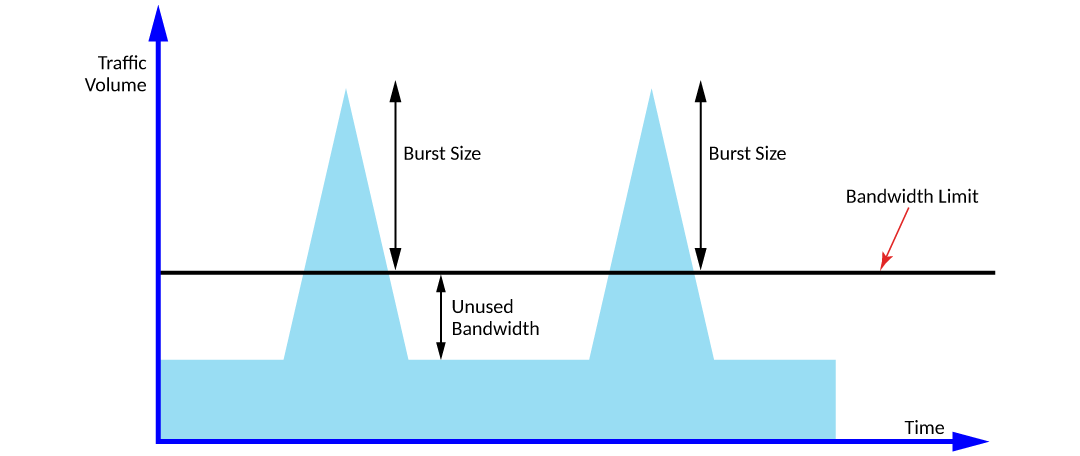
An example of this is, traffic coming into port 1 and going out of port 2 is a 1G link. The rate is limited to 10Mb on port one. This means only 10Mb data is going out of port 2. If only 9MB of traffic is sent, it will all go through without even hitting the set rate-limit. This leaves 1Mb of unused bandwidth. This 1Mb of unused bandwidth can be borrowed in case if a burst of packets comes in. Now, the “rate-limit fixed 10000 burst <burst size>” can be used if you want to restrict the borrowing of 1M to say only 0.1M.